
Four Treasures Reference Database
Record No. 26341
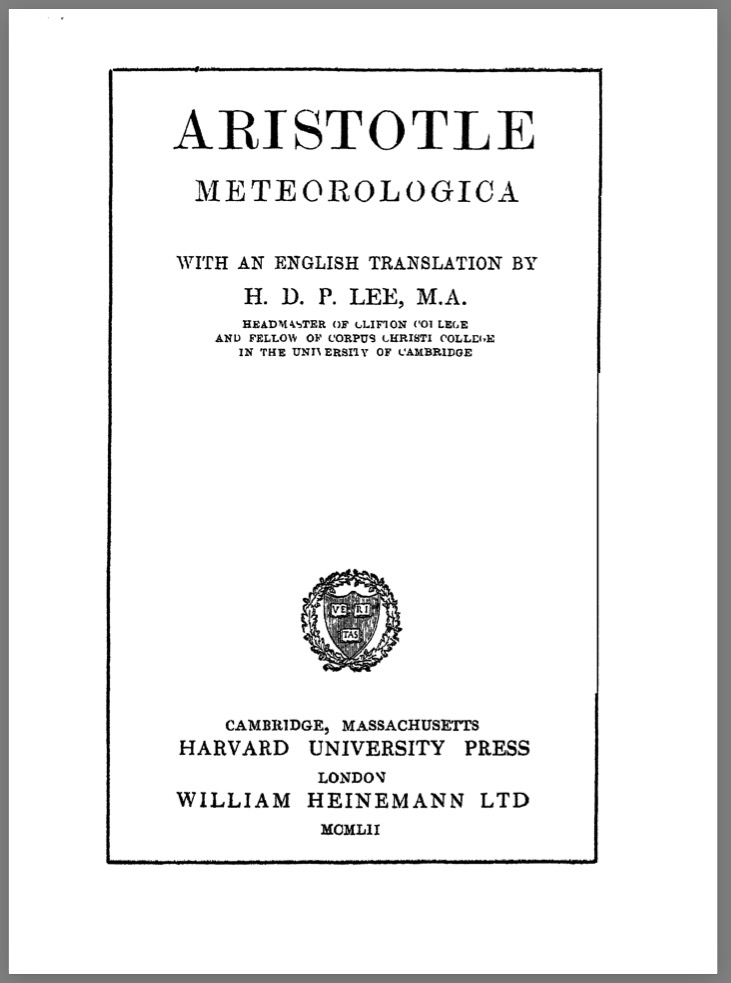
Meteorologica
Edited Book
Aristotle and Lee, H.D.P., editor (1952) Meteorologica.. Cambridge, MA, Harvard University Press, 397 pp..
Sinkankas/Born No.: NIS/NIB | Language: in English and Greek | RWHL*
gems, Greek science, Greek mineralogy, Arabic mineralogy
Aristotle’s Meteorologica is a foundational text in ancient natural philosophy that explores the causes and nature of atmospheric and celestial phenomena. Written in the 4th century BCE, the work is divided into four books and covers a wide range of subjects, including weather patterns, the formation of winds, clouds, rain, thunder, lightning, and celestial events such as comets and meteors. Aristotle also extends his inquiry to geological processes—such as earthquakes, volcanic eruptions, and the behavior of minerals—marking one of the earliest attempts at a unified natural science. Central to the Meteorologica is Aristotle’s theory of the four elements (earth, water, air, fire) and their transformations, which he uses to explain natural processes both in the heavens and on Earth. The text blends observation with philosophical reasoning, reflecting Aristotle’s broader interest in categorizing and systematizing knowledge about the natural world. Though many of its scientific claims were later superseded, Meteorologica significantly influenced medieval and early modern thinkers, shaping natural philosophy through the Renaissance and beyond.