
Four Treasures Reference Database
Record No. 26351
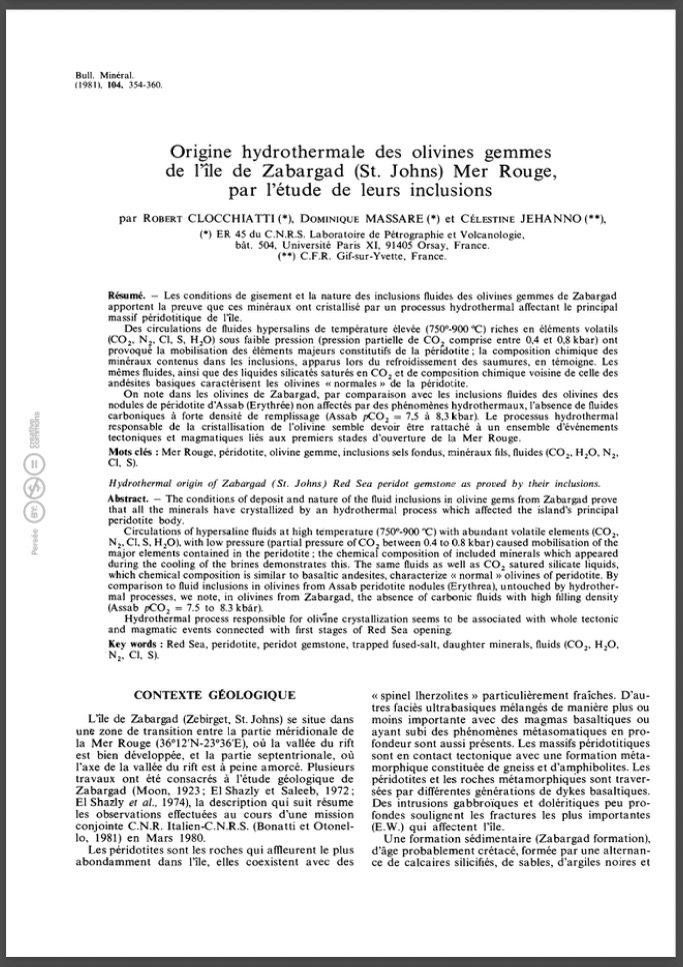
Origine hydrothermale des olivines gemmes de l’ile de Zabargad (St. John), Mer Rouge, par l’etude de leurs inclusions
Journal Article
Clochiatti, R., Massare, D. and Jehanno, C. (1981) Origine hydrothermale des olivines gemmes de l’ile de Zabargad (St. John), Mer Rouge, par l’etude de leurs inclusions. Bulletin de Minéralogie, No. 104, pp. 354–360.
Sinkankas/Born No.: NIS/NIB | Language: in French | RWHL
peridot, St. John’s Island, Egypt, gems, Classical world, geology, inclusions
Hydrothermal origin of gem olivines from Zabargad Island (St. John), Red Sea, through the study of their inclusions. The conditions of deposit and nature of the fluid inclusions in olivine gems from Zabargad prove that all the minerals have crystallized by an hydrothermal process which affected the island's principal peridotite body. Circulations of hypersaline fluids at high temperature (750°-900°C) with abundant volatile elements (CO₂, N₂, Cl, S, H₂O), with low pressure (partial pressure of CO₂ between 0.4 to 0.8 kbar) caused mobilisation of the major elements contained in the peridotite ; the chemical composition of included minerals which appeared during the cooling of the brines demonstrates this. The same fluids as well as CO₂ satured silicate liquids, which chemical composition is similar to basaltic andesites, characterize « normal » olivines of peridotite. By comparison to fluid inclusions in olivines from Assab peridotite nodules (Erythrea), untouched by hydrothermal processes, we note, in olivines from Zabargad, the absence of carbonic fluids with high filling density (Assab pCO₂ = 7.5 to 8.3 kbar). Hydrothermal process responsible for olivine crystallization seems to be associated with whole tectonic and magmatic events connected with first stages of Red Sea opening.