
Four Treasures Reference Database
Record No. 26395
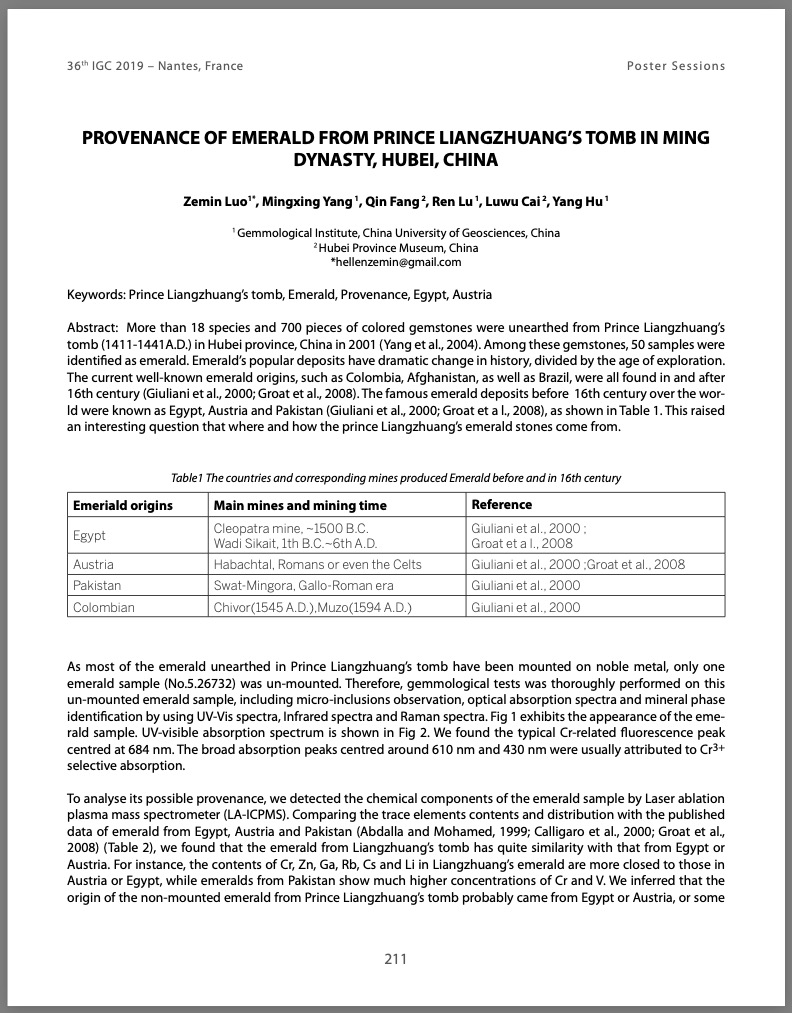
Provenance of emerald from Prince Liangzhuang’s tomb in Ming dynasty, Hubei, China
Conference Paper
Luo, Z., Yang, M., Fang, Q., Lu, R., Cai, L. and Hu, Y. (2019) Provenance of emerald from Prince Liangzhuang’s tomb in Ming dynasty, Hubei, China. 36th International Gemmological Conference, Nantes, France pp. 209–211.
Sinkankas/Born No.: NIS/NIB | RWHL*
Close Abstract
Hide Keywords
Copy Reference
gems, beryl, emerald, China, Egypt
In 2001, over 18 species and 700 pieces of colored gemstones were unearthed from the tomb of Prince Liangzhuang (1411–1441 A.D.) in Hubei province, China, including 50 identified emeralds (Yang et al., 2004). This discovery raises intriguing questions about the provenance of these emeralds, since major sources such as Colombia, Afghanistan, and Brazil were only discovered during or after the 16th century (Giuliani et al., 2000; Groat et al., 2008). Before that time, well-known emerald sources included Egypt, Austria, and Pakistan (Giuliani et al., 2000; Groat et al., 2008). To investigate, chemical analysis using laser ablation inductively coupled plasma mass spectrometry (LA-ICP-MS) was conducted on the emeralds from Liangzhuang’s tomb. Comparison of trace element concentrations (e.g., Cr, Zn, Ga, Rb, Cs, and Li) with published data from ancient sources (Abdalla and Mohamed, 1999; Calligaro et al., 2000; Groat et al., 2008) revealed a strong similarity with emeralds from Egypt or Austria, while those from Pakistan showed significantly higher Cr and V levels. The results suggest that the prince’s emeralds likely originated from Egypt or Austria, or perhaps from another now-forgotten source. This finding supports the idea that long-distance trade in emeralds between East and West may have existed before the Age of Exploration and the 15th-century maritime expeditions of Zheng He.