
Four Treasures Reference Database
Record No. 26401
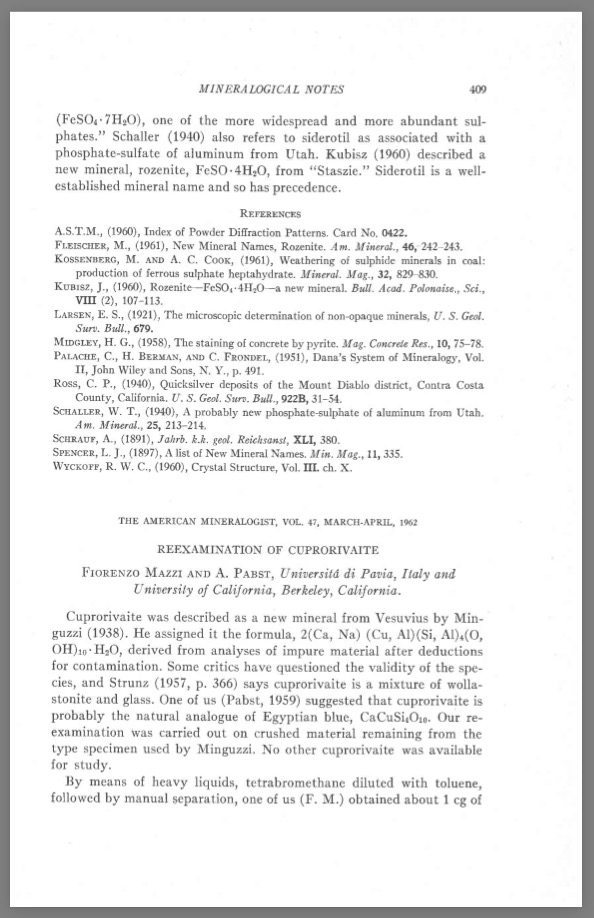
Reexamination of cuprorivaite
Journal Article
Mazzi, F. and Pabst, A. (1962) Reexamination of cuprorivaite. American Mineralogist, Vol. 47, March–April, pp. 409–411.
Sinkankas/Born No.: NIS/NIB | RWHL
gems, ancient gemology, early gemology, ancient mineralogy, early trade, Rome, Romans, Greeks, ancient trade, commerce, cuprorivate, Italy
Cuprorivaite was first described as a new mineral from Vesuvius by Minguzzi in 1938, who proposed the formula 2(Ca, Na)(Cu, Al)(Si, Al)₂(O, OH)₁₀·H₂O, based on analyses of impure material with adjustments for contamination. However, the validity of the species has been debated; Strunz (1957, p. 366), for instance, argued that cuprorivaite is merely a mixture of wollastonite and glass. One of the present authors, Pabst (1959), proposed instead that cuprorivaite is likely the natural analogue of Egyptian blue, CaCuSi₄O₁₀. A reexamination was conducted using crushed material from the original type specimen described by Minguzzi, as no other confirmed samples of cuprorivaite were available for further study.