
Four Treasures Reference Database
Record No. 26408
Emerald mineralisation in Colombia: Fluid chemistry and the role of brine mixing
Journal Article
Banks, D.A., Giuliani, G., Yardley, B.W.D. and Cheilletz, A. (2000) Emerald mineralisation in Colombia: Fluid chemistry and the role of brine mixing. Mineralium Deposita, Vol. 35, No. 8, pp. 699–713.
DOI: https://doi.org/10.1007/S001260050273 | RWHL*
Close Abstract
Hide Keywords
Copy Reference
gems, beryl, emerald, Colombia, geology, emerald formation
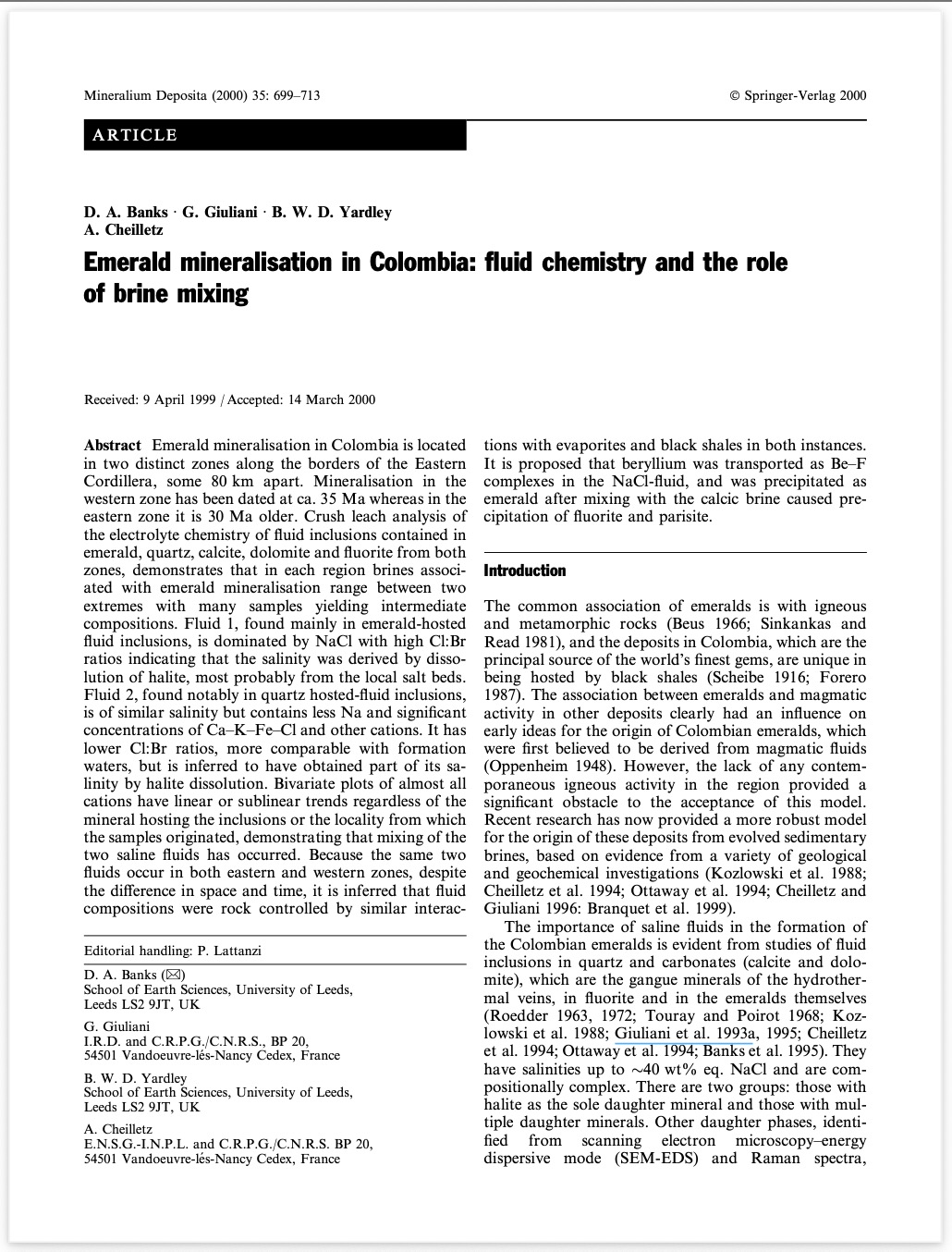
Emerald mineralisation in Colombia occurs in two separate zones along the margins of the Eastern Cordillera, approximately 80 km apart, with the western zone dated to around 35 million years ago and the eastern zone about 30 million years older. Crush-leach analysis of fluid inclusions in minerals such as emerald, quartz, calcite, dolomite, and fluorite from both zones reveals two distinct brine types associated with emerald formation, with many samples showing intermediate compositions. Fluid 1, primarily found in emerald-hosted inclusions, is dominated by NaCl and displays high Cl:Br ratios, indicating salinity from halite dissolution, likely sourced from local salt beds. Fluid 2, notably present in quartz-hosted inclusions, has similar salinity but contains lower Na and higher levels of Ca, K, Fe, and other cations, with lower Cl:Br ratios more typical of formation waters, though it also likely derives salinity in part from halite. Linear trends in bivariate plots of cation concentrations, regardless of host mineral or locality, confirm that mixing between the two fluids occurred. The presence of these same fluid types in both zones, despite differences in age and geography, suggests that fluid chemistry was controlled by similar interactions with evaporites and black shales in both cases. It is proposed that beryllium was transported as Be–F complexes in the NaCl-rich fluid and that emerald precipitated upon mixing with the calcic brine, which also triggered the precipitation of fluorite and parisite.