
Four Treasures Reference Database
Record No. 26423
A new type of reconstituted jadeite product
一种新的翡翠再造品
Journal Article
Zhang, X., Chen, S., Tang, J. and Yang, Y. (2003) A new type of reconstituted jadeite product. [一种新的翡翠再造品] Journal of Gems & Gemmology, Vol. 5, No. 1, March, pp. 5–6.
Sinkankas/Born No.: NIS/NIB | Language: in Chinese with English abstract | RWHL*
gems, jade, pyroxene jade, fei cui, treated jade, reconstructed jade, pressed jade, HPHT
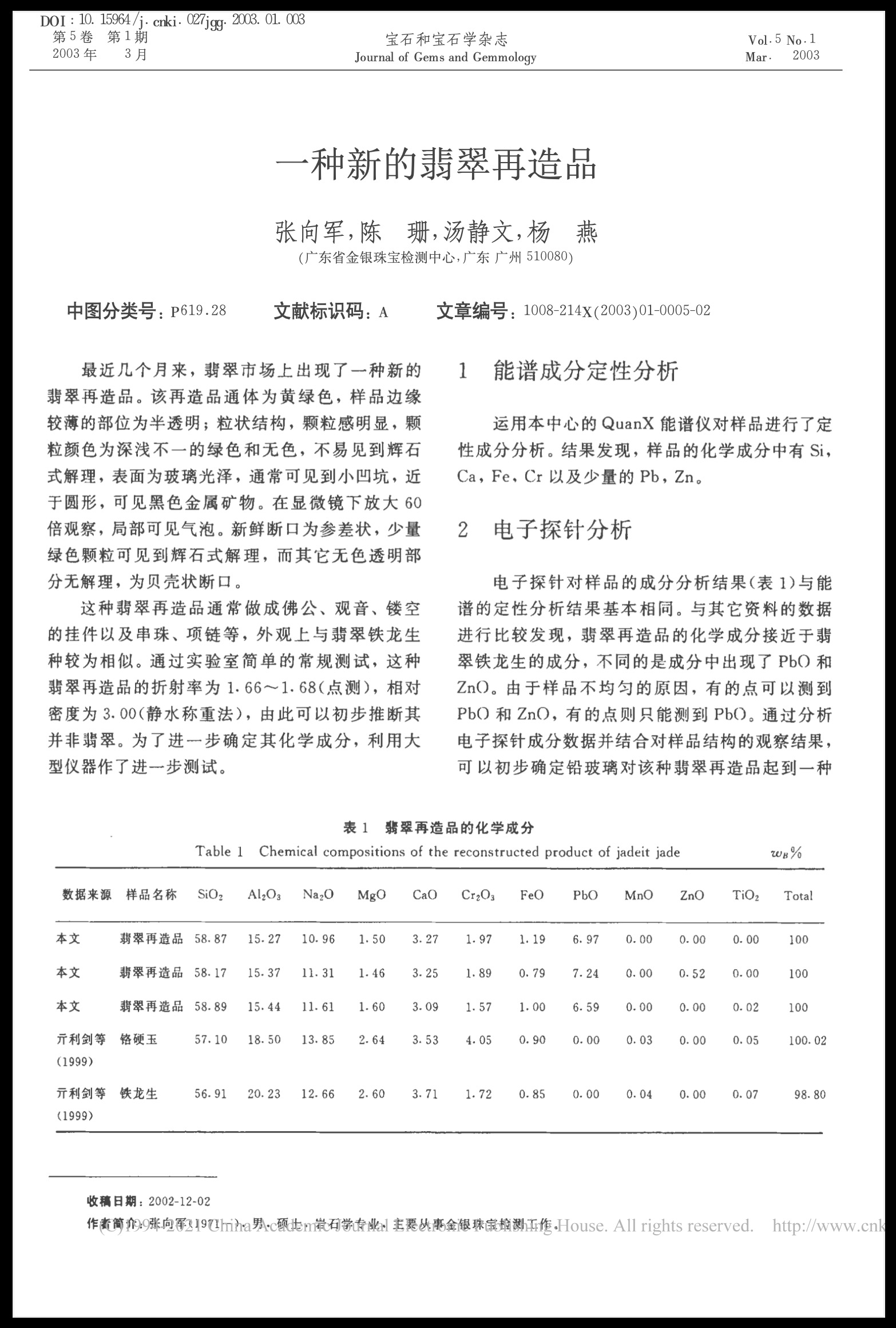
In recent months, a new type of reconstituted jadeite product has appeared on the jadeite market. This reconstituted material is yellow-green throughout, with thinner edges of the sample appearing semi-transparent. It has a granular structure with a noticeable grainy texture; the grains vary in color from different shades of green to colorless. Pyroxene-type cleavage is not easily observed. The surface has a vitreous luster and often displays small, nearly round pits, along with visible black metallic minerals. Under 60× magnification with a microscope, bubbles can be seen in some areas. Fresh fractures appear uneven; a few green grains show pyroxene-like cleavage, while other colorless transparent parts show no cleavage and have conchoidal fractures. This type of reconstituted jadeite is commonly made into Buddha figures, Guanyin pendants, openwork charms, beads, necklaces, and other items. In appearance, it closely resembles the “Tie Longsheng” variety of jadeite. Simple routine tests conducted in a laboratory show that its refractive index ranges from 1.66 to 1.68 (spot reading), and its specific gravity is 3.00 (measured by hydrostatic weighing). From this, it can be preliminarily concluded that the material is not genuine jadeite. To further determine its chemical composition, large-scale instrument analysis was carried out.