
Four Treasures Reference Database
Record No. 26428
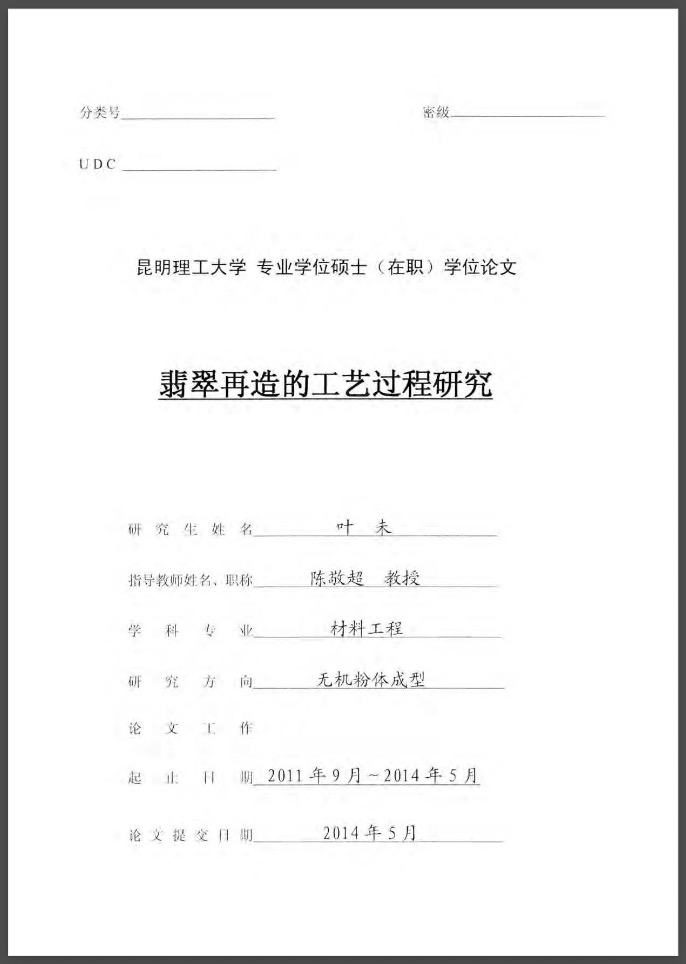
A Study on the Reconstitution Process of Jadeite
翡翠再造的工艺过程研究
Thesis
Xian, J. (2014) A Study on the Reconstitution Process of Jadeite. [翡翠再造的工艺过程研究]., Kunming: Kunming University of Science and Technology, 69 pp.
Sinkankas/Born No.: NIS/NIB | Language: in Chinese with English abstract | RWHL
gems, jade, pyroxene jade, jadeite, fei cui, synthetic jadeite, synthetic fei cui, simulants, HPHT
Synthetic Chinese Fei Cui (jadeite) has recently been prepared using high-pressure hydrothermal methods, but significant bottlenecks remain due to the complexity of phase formation and transitions, as well as the poor solubility of color-causing elements. Jadeite typically forms not as a single crystal but as an aggregate of multiple crystals containing more jadeite than associated minerals like albite, omphacite, and hornblende. The high-temperature, high-pressure equipment required for synthesis also poses challenges, resulting in products too small for commercial viability. This study aims to conserve natural jadeite resources by reconstructing new jadeite materials from leftover scraps and lower-grade jadeite. The process includes grinding and magnetic separation of hornblende and iron-bearing minerals, mixing Cr₂O₃ (the color-causing agent) with matrix materials via high-energy ball milling, followed by powder compaction, and then applying either high-pressure hydrothermal or spark plasma sintering (SPS) techniques to the green body. The study investigates how compaction and sintering processes affect granularity, density, composition, and phase transitions. IR spectra show that structural water is absent in hydrothermal-sintered samples, while borate glass, used as an additive, improves both density and sinterability. As a result, the synthesized material’s density, color distribution, refractive index, and mineral composition closely approximate natural jadeite. Upon heating, jadeite undergoes two types of phase transformations: NaAlSi₂O₆ → NaAlSiO₄ + SiO₂, and 2NaAlSi₂O₆ → NaAlSiO₄ + NaAlSi₃O₈. X-ray and DSC analysis reveal that sintering method influences the resulting phases: hydrothermal sintering yields NaAlSiO₄ + SiO₂, while SPS produces NaAlSi₃O₈. These changes arise from the shift in aluminum coordination from octahedral to tetrahedral, which requires additional energy and results in volume expansion. Using first-principles calculations, the study also explores the mechanism of color development and crystal structure stability, modeling Cr substitution for Al in the jadeite lattice. Simulation results show that the forbidden band near the Fermi level narrows from 5.0 eV to 2.0 eV, enabling visible light to excite electrons from the valence to the conduction band due to Cr substitution and Al vacancies. The corresponding absorption wavelength, calculated as 652 nm (E = 2.0 eV), matches experimental observations. Simulations of phase transformations under pressure indicate that the jadeite unit cell volume decreases linearly from 0 GPa to 20 GPa, with a noticeable plateau between 6 and 10 GPa, suggesting a pressure-induced phase transition. The enthalpy of formation analysis shows that at lower pressures, jadeite is less stable than nepheline, with a predicted transformation pressure of 11.06 GPa.