
Four Treasures Reference Database
Record No. 26434
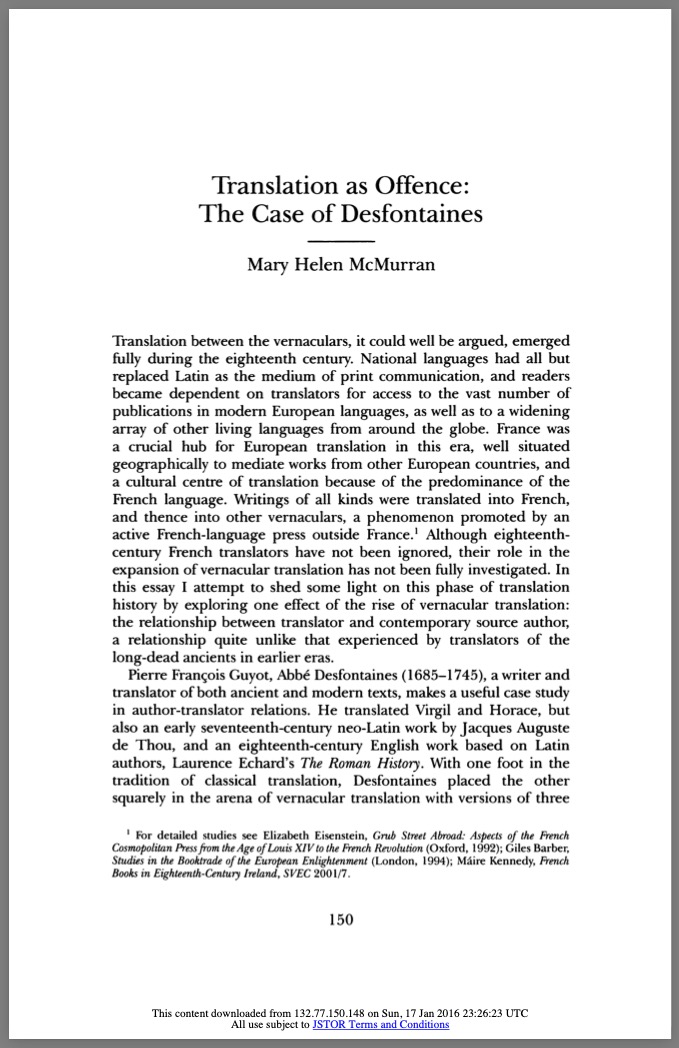
Translation as offence: The Case of Desfontaines
Journal Article
McMurran, M.H. (2008) Translation as offence: The Case of Desfontaines. Translation and Literature, Vol. 17, No. 2, Autumn, pp. 150–164.
Sinkankas/Born No.: NIS/NIB | RWHL
gems, ancient gemology, early gemology, ancient mineralogy, early trade, Rome, Romans, Greeks, ancient trade, commerce, translation
Translation between vernacular languages fully emerged in the eighteenth century, as national languages had largely replaced Latin as the primary medium of print communication. Readers increasingly relied on translators to access a growing body of publications in modern European languages, as well as a widening range of global vernaculars. During this period, France became a key hub for European translation—both geographically well-positioned to mediate works from other countries and culturally dominant due to the widespread use of the French language. Texts of all kinds were translated into French and then into other vernaculars, a process supported by an active French-language press even outside France. Although eighteenth-century French translators have received some attention, their broader role in the growth of vernacular translation remains underexplored. This essay aims to illuminate that phase of translation history by examining one of its defining features: the evolving relationship between translators and contemporary source authors—a relationship markedly different from that of translators working with ancient texts in earlier periods.