
Four Treasures Reference Database
Record No. 26471
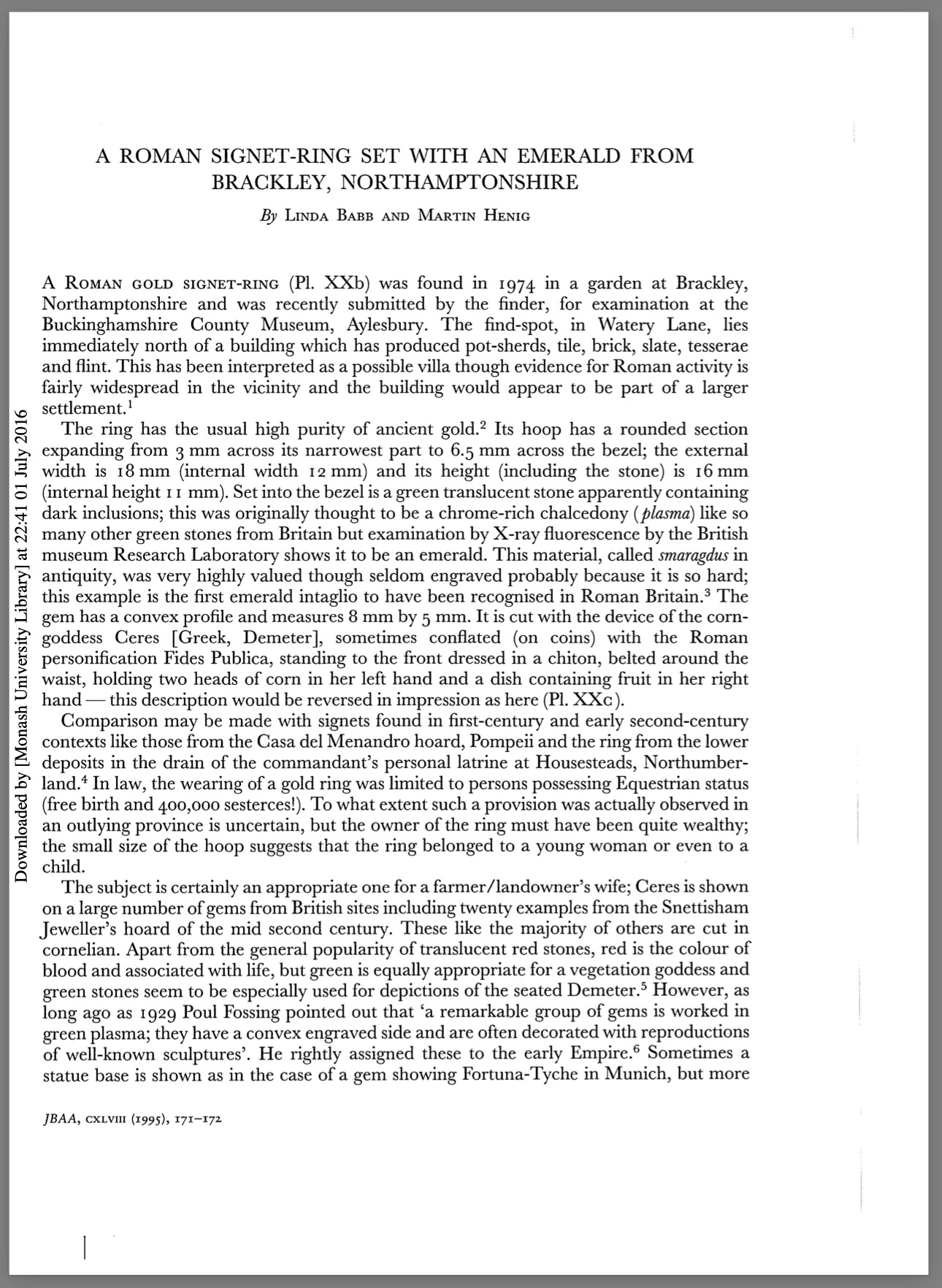
A Roman signet-ring set with an emerald from Brackley, Northamptonshire
Journal Article
Babb, L. and Henig, M. (1995) A Roman signet-ring set with an emerald from Brackley, Northamptonshire. Journal of the British Archaeological Association, Vol. 148, No. 1, pp. 171–172.
gems, glyptic, engraved gems, agate, cameo, intaglio, Rome, Roman gems, history of gemology
A Roman gold signet-ring (Pl. XXb) was discovered in 1974 in a garden at Brackley, Northamptonshire, and was later submitted by the finder for examination at the Buckinghamshire County Museum, Aylesbury. The find-spot, located in Watery Lane, lies just north of a building that has yielded pot-sherds, tile, brick, slate, tesserae, and flint—suggesting a possible villa, though Roman activity appears widespread in the area, indicating the building may have been part of a larger settlement. The ring is made of high-purity ancient gold and features a hoop with a rounded section that expands from 3 mm at its narrowest point to 6.5 mm at the bezel; its external width is 18 mm (internal width 12 mm) and its height, including the stone, is 16 mm (internal height 11 mm). Set into the bezel is a green translucent stone with dark inclusions, initially believed to be a chrome-rich chalcedony (plasma), as is common in Britain, but identified through X-ray fluorescence analysis by the British Museum Research Laboratory as an emerald. Known in antiquity as smaragdus, emeralds were highly prized though rarely engraved due to their hardness—making this the first known emerald intaglio from Roman Britain. The gem, which has a convex profile and measures 8 mm by 5 mm, is engraved with the image of the corn-goddess Ceres (Greek, Demeter), sometimes conflated with the Roman Fides Publica on coins. She is depicted standing frontally, dressed in a belted chiton, holding two heads of corn in her left hand and a dish of fruit in her right—an image that would appear in reverse in impression (Pl. XXc).