
Four Treasures Reference Database
Record No. 26494
Cu³⁺ ion in corundum
Journal Article
Blumberg, W.E., Eisinger, J. and Geschwind, S. (1963) Cu³⁺ ion in corundum. Physical Review, Vol. 130, No. 3, pp. 900–909.
gems, corundum, color.4, causes of color, dopants, copper, Cu, chromophores
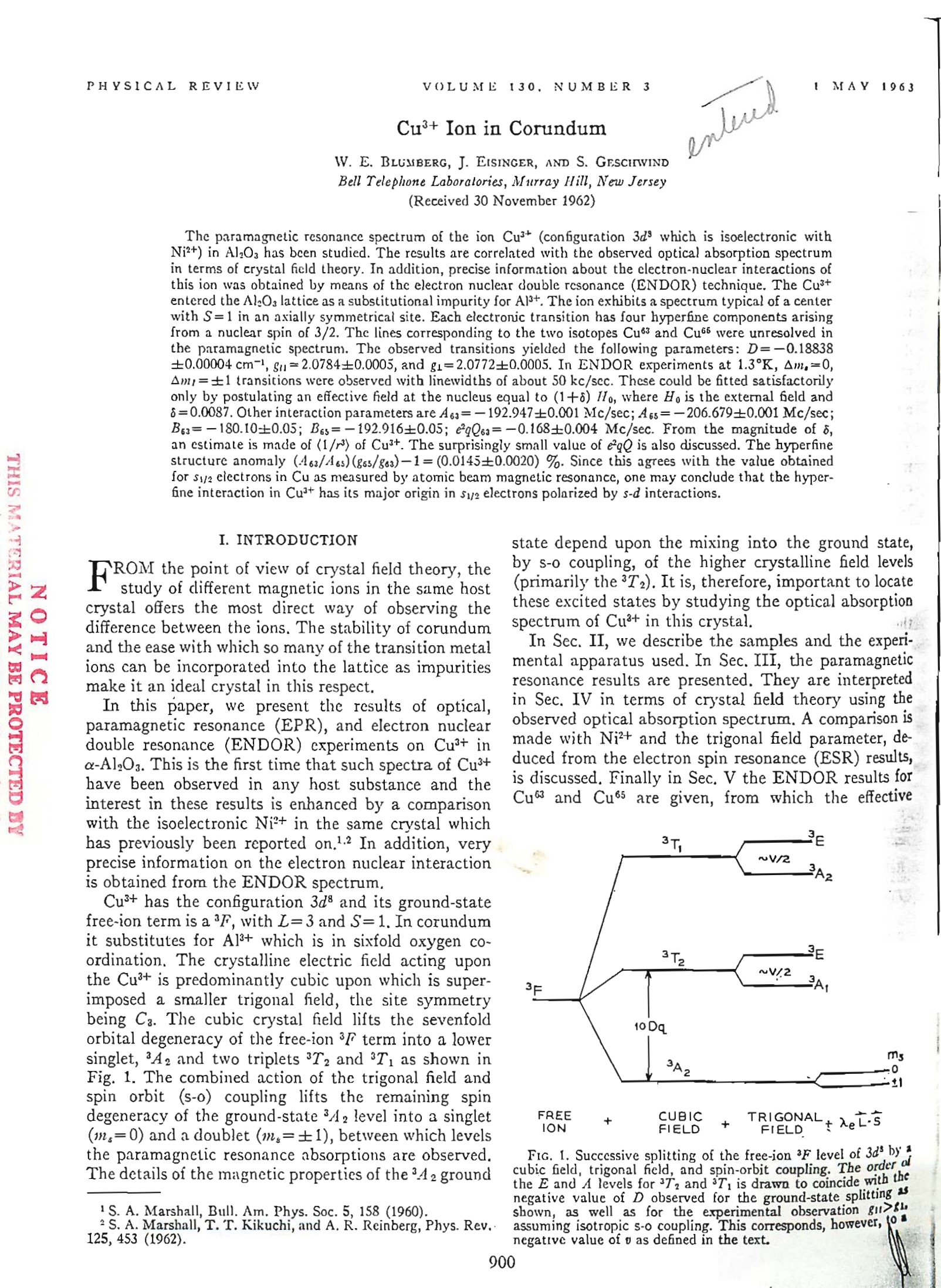
The paramagnetic resonance spectrum of the ion Cu³⁺ (configuration 3d⁸, which is isoelectronic with Ni²⁺) in Al₂O₃ has been studied. The results are correlated with the observed optical absorption spectrum in terms of crystal field theory. In addition, precise information about the electron-nuclear interactions of this ion was obtained by means of the electron nuclear double resonance (ENDOR) technique. The Cu³⁺ entered the Al₂O₃ lattice as a substitutional impurity for Al³⁺. The ion exhibits a spectrum typical of a center with S = 1 in an axially symmetrical site. Each electronic transition has four hyperfine components arising from a nuclear spin of 3/2. The lines corresponding to the two isotopes Cu⁶³ and Cu⁶⁵ were unresolved in the paramagnetic spectrum. The observed transitions yielded the following parameters: D = −0.18838 ± 0.00004 cm⁻¹, g∥ = 2.0784 ± 0.0005, and g⊥ = 2.0772 ± 0.0005. In ENDOR experiments at 1.3°K, Δm_s = 0, Δm_I = ±1 transitions were observed with linewidths of about 50 kc/sec. These could be fitted satisfactorily only by postulating an effective field at the nucleus equal to (1 + δ) H₀, where H₀ is the external field and δ = 0.0087. Other interaction parameters are A₆₃ = −192.947 ± 0.001 Mc/sec; A₆₅ = −206.679 ± 0.001 Mc/sec; B₆₃ = −180.10 ± 0.05; B₆₅ = −192.916 ± 0.05; eqQ₆₃ = −0.168 ± 0.004 Mc/sec. From the magnitude of δ, an estimate is made of ⟨1/r³⟩ of Cu³⁺. The surprisingly small value of eqQ is also discussed. The hyperfine structure anomaly (A₆₃/A₆₅)(g₆₅/g₆₃) − 1 = (0.0145 ± 0.0020) %. Since this agrees with the value obtained for s₁/₂ electrons in Cu as measured by atomic beam magnetic resonance, one may conclude that the hyperfine interaction in Cu³⁺ has its major origin in s₁/₂ electrons polarized by s–d interactions.