
Four Treasures Reference Database
Record No. 26519
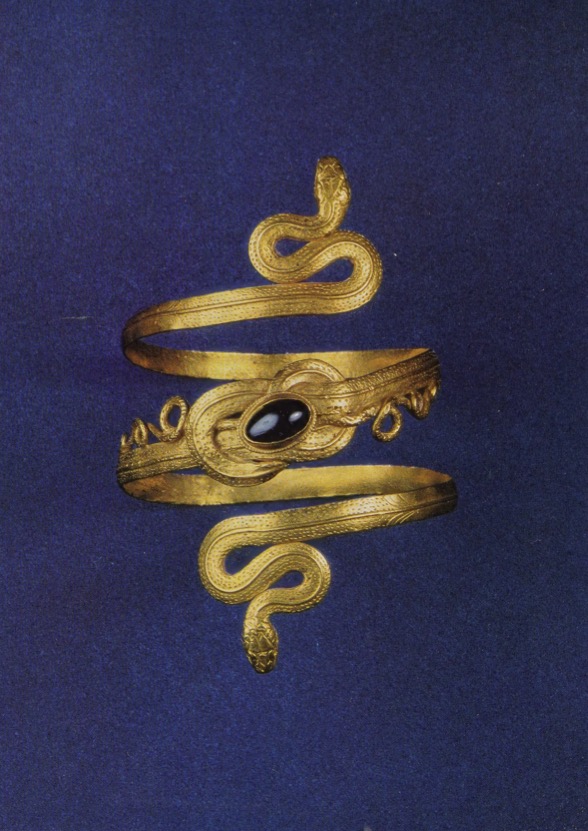
Greek Gold | Jewelry from the Age of Alexander
Book
Hoffman, H. and Davidson, P.F. (1966) Greek Gold | Jewelry from the Age of Alexander. Boston, Museum of Fine Arts, Boston, 312 pp.
ISBN/ISSN: LC: 6526949 | Sinkankas/Born No.: NIS | RWHL
gems, ancient gemology, ancient jewelry, Greece, Greek, Egyptian, gold jewelry, Alexander the Great
Until recently, our understanding of early Hellenistic jewelry relied almost entirely on the spectacular Greek gold finds made in South Russia during the nineteenth century, now housed in the Hermitage Museum. Between the two world wars, similar discoveries emerged in northern Greece—particularly in Thessaly and Macedonia—thanks to finds by local peasants. The most notable hoards, reportedly from Carpenisi and Demetrias, were divided between the Benaki and Stathatos collections in Athens, the latter now part of the National Museum. While the Hermitage’s holdings are primarily known through nineteenth-century publications and travel to Leningrad, the Benaki and Stathatos gold has been well documented in two exemplary catalogues. Nonetheless, knowledge of Greek jewelry from the Age of Alexander remained fragmented. In the past decade, however, this picture has changed dramatically. A wave of important discoveries—largely from clandestine excavations in northern Greece, Asia Minor, and other regions—has entered both private and institutional collections in Europe and America, while official excavations have also yielded substantial new material, much of which remains unpublished or entirely unknown. The exhibition Greek Gold from the Age of Alexander was conceived to bring together, for the first time, many of these remarkable works. Of the 148 groups of objects selected, 83 come from private collections, 68 are illustrated here for the first time, and three-quarters have never before been publicly exhibited. Dr. Herbert Hoffmann, drawing on his deep expertise and familiarity with European collections, assembled one of the most impressive displays of Greek jewelry ever seen. During a year at the University of Heidelberg’s Institute of Classical Archaeology, he traveled extensively across Europe to secure loans for the exhibition. Patricia F. Davidson, Research Associate at The Brooklyn Museum and a trained goldsmith, contributed her specialized knowledge of ancient techniques, reproducing methods based on her microscopic analyses using tools and materials believed to be historically accurate. She was assisted by William J. Young, Head of the Research Laboratory at the Museum of Fine Arts, Boston, who used X-ray fluorescence and other non-destructive tests to analyze alloy and inlay compositions. The catalogue addresses not only the stylistic, historical, and iconographic aspects of Hellenistic gold but also its technology, with schematic drawings by Suzanne E. Chapman of the MFA, Boston, some based on sketches by Helmut Prüickner of Heidelberg University.