
Four Treasures Reference Database
Record No. 26533
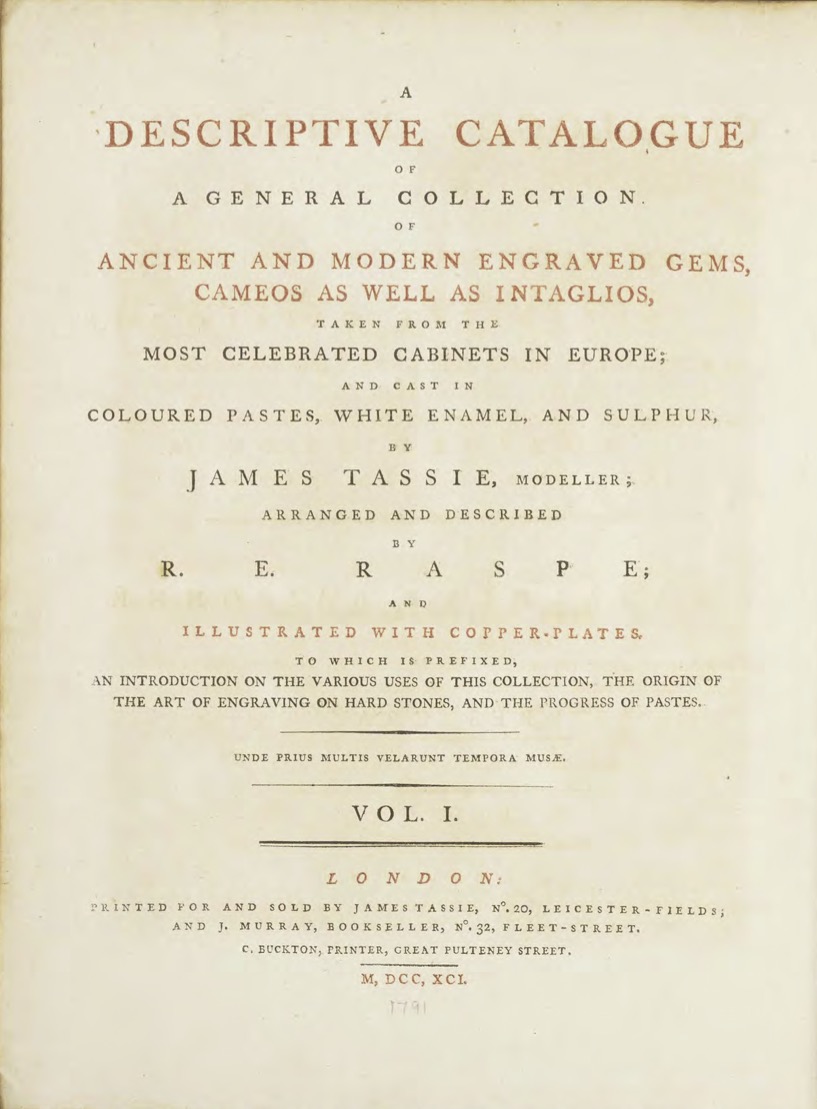
A Descriptive Catalogue of a General Collection of Ancient and Modern Engraved Gems, Cameos as well as Intaglios, taken from the most Celebrated Cabinets in Europe and Cast in Coloured Pastes, White Enamel, and Sulphur, by James Tassie, modeller
Book
Raspe, R.E. and Tassie, J. (1791) A Descriptive Catalogue of a General Collection of Ancient and Modern Engraved Gems, Cameos as well as Intaglios, taken from the most Celebrated Cabinets in Europe and Cast in Coloured Pastes, White Enamel, and Sulphur, by James Tassie, modeller. London, James Tassie, 2 Vols., 496, 497–800 pp.
Sinkankas/Born No.: 5357 | RWHL*
gems, glyptic, engraved gems, agate, cameo, intaglio
Sinkankas: C.W. King, in Antique Gems and Rings (vol. 1, p. 467), provides a valuable summary of this important work by the learned Rudolf Erich Raspe, describing it as an explanatory catalogue of the 15,800 pastes made by James Tassie from engraved gems of all classes and periods. King praises the book as a highly serviceable commentary, enriched by short essays on the history of various gem series, interpretations of mythological subjects, and insightful remarks on artists and collectors, making it an enduring guide to the study of engraved gems. The plates, etched by D. Allan of Edinburgh, are noted for their sketchy but tasteful style and accurate grasp of subject matter, though their shallow impressions often resulted in poor preservation, which contributed to the book’s mixed reception. Vinet (no. 1641) notes Raspe’s apology for his “bad French” but criticizes his “lack of decency and good taste” in handling certain explicit subjects—possibly those referenced by Goodland in Bibliography of Sex Rites (p. 501). In contrast to King’s appreciative tone, Adolf Furtwängler in Die Antiken Gemmen (vol. 3, p. 420) condemns the work as “scientifically worthless” with “badly drawn plates” and a lack of genuine critical insight, despite the author’s appearance of scholarly rigor. The Zazoffs also offer critical commentary in Gemmensammler (pp. 171–174). The text is presented in parallel English and French columns, beginning with a general treatise on engraved gems—broad in scope though not exhaustive—followed by the main catalogue, which fills most of the first volume and all of the second. Supplementary material includes additional gem entries, a list of European collections and their proprietors, a register of notable gem engravers, inscriptions, principal subjects, a concordance of Tassie’s portrait replicas, and a table of cross-references. The plates range from Egyptian motifs and cylinder seals to engraved gems spanning classical to modern times. The Tassie reproductions owe their existence to the discovery, shortly after 1763, of a fusible lead-potash glass called “white enamel composition,” developed by James Tassie in collaboration with Dr. Henry Quin, who experimented with gem imitations in his Dublin laboratory. According to the Dictionary of National Biography, Tassie skillfully varied the color, transparency, and layering of his casts to mimic true cameos. He also provided casts to Wedgwood and Bentley, many of which appear in Wedgwood’s 1773 catalogue. James Tassie, born near Glasgow in 1735, studied modeling at the Foulis Academy before traveling to Dublin and eventually settling in London, where he died in 1799. His nephew William Tassie (1777–1860) succeeded him, continuing the business and issuing catalogues in 1816, 1820, and 1830. Though earlier catalogues such as the 1775 edition listed just over 3,000 items, by 1781 the collection had grown to over 20,000 casts, many of which were executed with great skill and widely distributed, making the catalogue not only a scholarly resource but also a commercial triumph in the history of gem reproduction.