
Four Treasures Reference Database
Record No. 26620
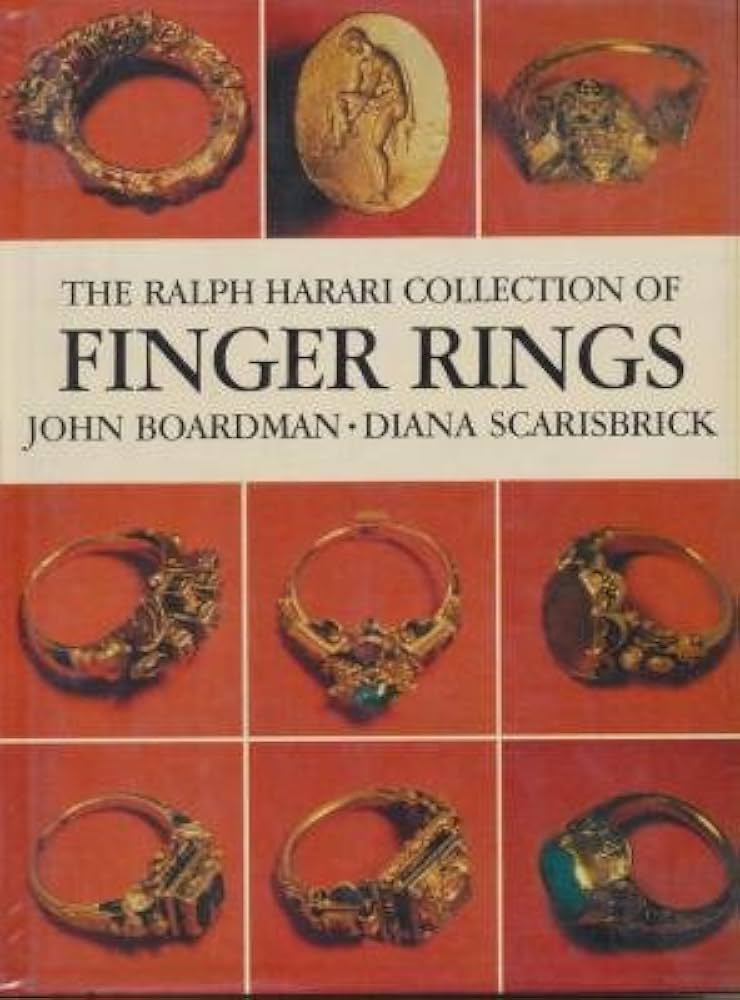
The Ralph Harari Collection of Finger Rings
Book
Boardman, J. and Scarisbrick, D. (1977) The Ralph Harari Collection of Finger Rings. London, Thames & Hudson, 149 pp.
Sinkankas/Born No.: 730; NIB | not seen
gems, glyptic, engraved gems, agate, cameo, intaglio, rings, Greece, Rome
Finger rings call upon the arts of the goldsmith, engraver, and jeweler. They are objects which, from antiquity, have been regarded as so highly personal that they can carry and confer personal authority, either in themselves or by use as signets; they can be credited with magical or amuletic properties; and as purely decorative jewelry they have been given, exchanged and worn, by men and women, to the present day. The tradition is a continuous one—from the Egyptian ring with its hieroglyphic inscription, the Etruscan scarab on its swivel ring, the Classical Greek gold signet, and Roman ring with engraved stone, to the heraldic rings of Byzantium and of Renaissance and modern Europe; from the rings conferred and worn by Popes and Cardinals to the English posy ring or lover’s gift. The collection presented here demonstrates all these uses with prime examples. Ralph Harari, soldier and diplomat, died in 1969. To a notable and exciting career in public service he added an interest in art and collecting which he indulged with singular perception and taste. He acquired important collections of Japanese drawings and paintings; of Beardsley drawings; and also of finger rings. These, drawn partly from private purchase and partly from the sales of older collections, include examples from such important cabinets as the Marlborough, Southesk, Guilhou, Pichon and Tysziewicz. As a result, the strength of the collection lies in its Greek gold rings, European heraldic rings, and Renaissance decorative rings, but the range and quality of the pieces demonstrate the arts of the jeweler and engraver in many different periods and lands, from the ancient Egyptian to the neo-Classical, from the European to Islamic. The collection is augmented by examples of engraved gems, many of which were made for setting in rings. The descriptive catalogue, with discussion and enlarged photographs of every item, has been prepared by John Boardman, author of several books on ancient gem engraving, and Diana Scarisbrick, herself a collector. With 382 illustrations, 10 in color. Sinkankas: This work describes the collection of Colonel Ralph Andrew Harari (1893–1969), an economist of Egyptian extraction, with additional biographical details provided on pages 7–9. It covers various classes of rings—many set with gems—including Greek intaglios and cameos, Etruscan scarabs and rings, Hellenistic, Italic, and Roman intaglios and cameos, as well as rings from the ancient Near East and Egypt, Sassanian intaglios, Byzantine and Merovingian rings and gems, and some modern examples. The descriptions are detailed, providing information on size, stone, inscriptions, provenance, references, and more, accompanied by photographs ranging from good to very good in quality. In 1975, the collection came into the possession of S.J. Phillips Ltd. of London.