
Four Treasures Reference Database
Record No. 26649
Close work without magnifying lenses?
Journal Article
Gorelick, L. and Gwinnett, A.J. (1981) Close work without magnifying lenses? Expedition, Vol. 23, No. 2, Winter, pp. 27–34.
Sinkankas/Born No.: NIS/NIB | RWHL*
gems, ancient gemology, ancient jewelry, greece, Greek, Egyptian, gold jewelry, Alexander the Great, glyptic, engraved gems, lapidary, ancient lapidary, Arabic mineralogy
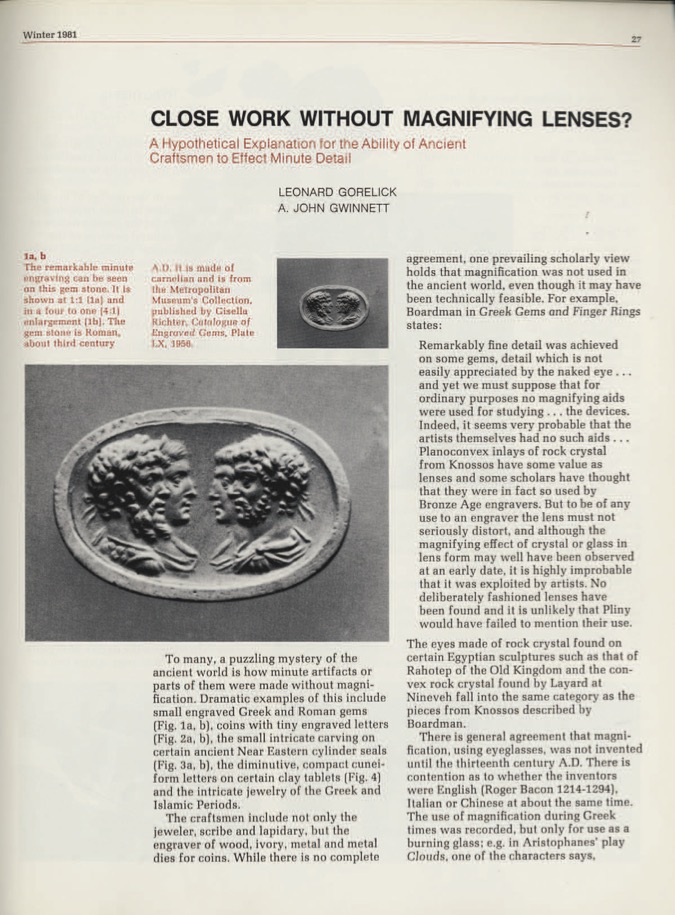
To many, a puzzling mystery of the ancient world is how minute artifacts or parts of them were made without magnification. Dramatic examples of this include small engraved Greek and Roman gems (Fig. la, b), coins with tiny engraved letters (Fig. 2a, b), the small intricate carving on certain ancient Near Eastern cylinder seals (Fig. 3a, b), the diminutive, compact cuneiform letters on certain clay tablets (Fig. 4) and the intricate jewelry of the Greek and Islamic Periods. The craftsmen include not only the jeweler, scribe and lapidary, but the engraver of wood, ivory, metal and metal dies for coins. While there is no complete agreement, one prevailing scholarly view holds that magnification was not used in the ancient world, even though it may have been technically feasible. For example, Boardman in Greek Gems and Finger Rings states: Remarkably fine detail was achieved on some gems, detail which is not easily appreciated by the naked eye and yet we must suppose that for ordinary purposes no magnifying aids were used for studying … the devices. Indeed, it seems very probable that the artists themselves had no such aids … Planoconvex inlays of rock crystal from Knossos have some value as lenses and some scholars have thought that they were in fact so used by Bronze Age engravers. But to be of any use to an engraver the lens must not seriously distort, and although the magnifying effect of crystal or glass in lens form may well have been observed at an early date, it is highly improbable that it was exploited by artists. No deliberately fashioned lenses have been found and it is unlikely that Pliny would have failed to mention their use. The eyes made of rock crystal found on certain Egyptian sculptures such as that of Rahotep of the Old Kingdom and the convex rock crystal found by Layard at Nineveh fall into the same category as the pieces from Knossos described by Boardman. There is general agreement that magnification, using eyeglasses, was not invented until the thirteenth century A.D. There is contention as to whether the inventors were English (Roger Bacon 1214-1294), Italian or Chinese at about the same time. The use of magnification during Greek times was recorded, but only for use as a burning glass; e.g. in Aristophanes’ play Clouds, one of the characters says. When a summons is sent to me I will take this stone (i.e. burning glass) and place myself in the sun, I will at a distance melt all the writings of the summons. In China the burning glass was used for cautery. The purpose of this article is to explain, in hypothetical terms, how very close work, which today would be done under magnification, could have been accomplished in ancient times without it.