
Four Treasures Reference Database
Record No. 26650
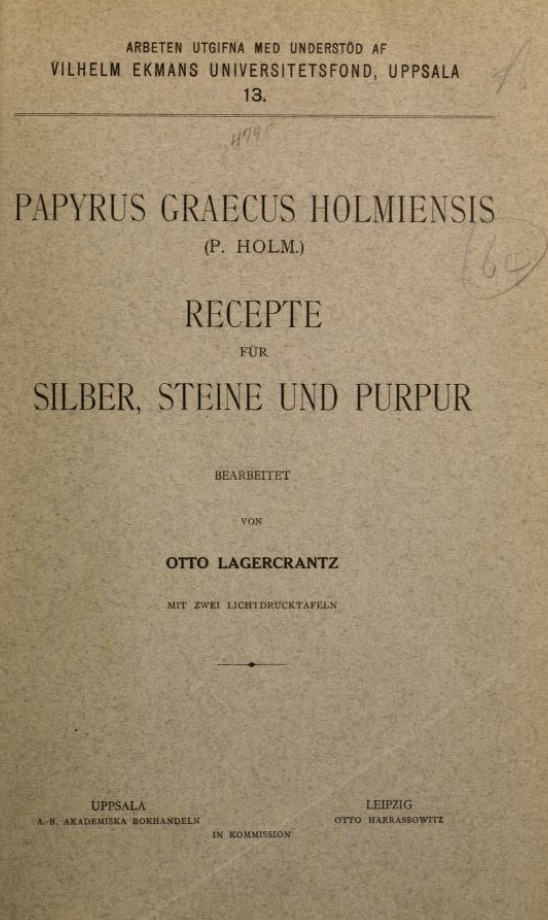
Papyrus Graecus Holmiensis (P. Holm.): Recepte Für Silber, Steine und Purpur
Papyrus Graecus Holmiensis (P. Holm.): Recipes for Silver, Stones, and Purple Dye
Book
Lagercrantz, O. (1913) Papyrus Graecus Holmiensis (P. Holm.): Recepte Für Silber, Steine und Purpur. [Papyrus Graecus Holmiensis (P. Holm.): Recipes for Silver, Stones, and Purple Dye] Uppsala, Almqvist & Wiksells Boktryckeri-A.-B., 247 pp.
Sinkankas/Born No.: 3749; NIB | Language: in Greek and German | RWHL*
gems, ancient gemology, ancient jewelry, Egypt, Egyptian jewelry, beryl, emerald, turquoise, malachite, gem treatments, dying,
The Papyrus Graecus Holmiensis (also known as the Stockholm Papyrus) is a collection of craft recipes compiled in Egypt c. 300 AD. It is written in Greek. The Stockholm Papyrus has 154 recipes for dyeing, coloring gemstones, cleaning (purifying) pearls, and imitation gold and silver.[1] Certain of them may derive from the Pseudo-Democritus. Zosimos of Panopolis, an Egyptian alchemist of c. 300 AD, gives similar recipes. Some of these recipes are found in medieval Latin collections of technological recipes, notably the Mappae clavicula. Leyden Papyrus X derives from the same (or very similar) sources, and is written in a similar (possibly the same) hand, using chemically identical ink.[2][3] The Stockholm papyrus and Leyden Papyrus X were both found in Thebes by Giovanni Anastasi, who donated the Leyden Papyrus to the Dutch government in 1828 and the Stockholm Papyrus to the Swedish government in 1832. The Stockholm papyrus was first published by Otto Lagercrantz in 1913. Whereas Leyden papyrus X deals with metallurgy, the Stockholm papyrus deals with gems, pearls and textile dyeing. Sinkankas: The extensively annotated papyrus manuscript here may be as old as the end of the third or the beginning of the fourth century BC; it is in the Swedish Academy of Antiquities, Stockholm, and is believed to be the companion to another papyrus of the Johann d’Anastasy collection in Leyden, entitled P. Leid. X. The present papyrus, called Papyrus Graecus Holmiensis or P. Holm., consists of 15 leaves and that portion of the text, p. 157–200, consisting of about 70 recipes for cleansing pearls and manufacturing a variety of gemstones, is of greatest interest here to show how advanced the arts of deception had become at so early a stage in gemological history. Among the gemstones to be “manufactured” by various means are carnelian, lapis lazuli, emerald, pearl, ruby, “green stones,” beryl, amethyst, chrysolite, and chrysoprase, and also “lychnis,” jasper, sunstone, procedures for purifying rock crystal and pearls, etching or corroding gemstones, altering their color, or softening them, and removing color. Unfortunately, Lagercrantz provides no useful commentary on the technological merits of the recipes, but it is obvious from merely reading these recipes that most treatments are by far superficial or even cosmetic, and, in some instances, not only ineffective but actually destructive, e.g., to pearls. In several recipes which claim to change one gemstone into another, usually rock crystal into emerald or the like, the formulas call for pigmenting agents which penetrate fissures in the quartz and impart superficial coloration. K. Nassau, Gemstone Enhancement, p. 81–112, provides an extended commentary with extracts from this work.