
Four Treasures Reference Database
Record No. 26652
The origin and development of the ancient Near Eastern cylinder seal: A hypothetical reconstruction
Journal Article
Gorelick, L. and Gwinnett, A.J. (1981) The origin and development of the ancient Near Eastern cylinder seal: A hypothetical reconstruction. Expedition, Vol. 23, No. 4, Summer, pp. 17–30.
Sinkankas/Born No.: NIS/NIB | RWHL*
gems, glyptic, engraved gems, agate, cameo, intaglio, seals, Greek seals, cylinder seals, Mesopotamia, Sumeria, lapidary arts, lapidary history, history, technology
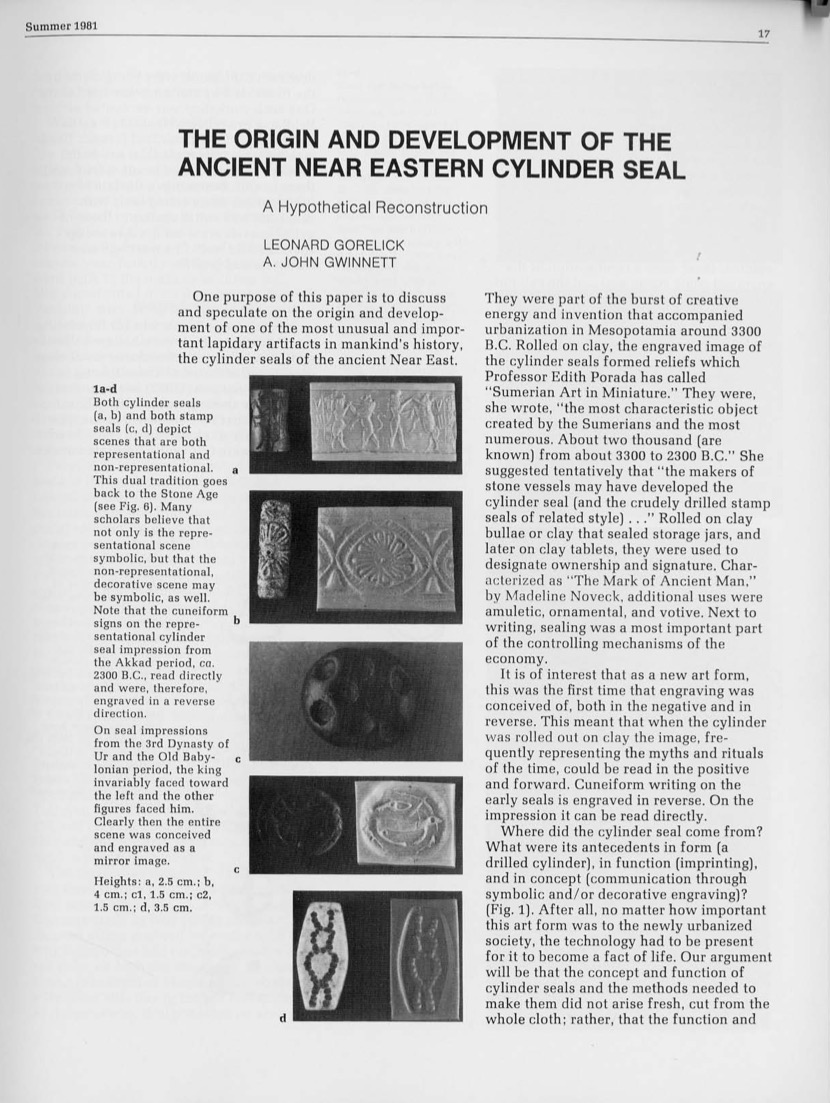
One purpose of this paper is to discuss and speculate on the origin and development of one of the most unusual and important lapidary artifacts in mankind’s history, the cylinder seals of the ancient Near East. They were part of the burst of creative energy and invention that accompanied urbanization in Mesopotamia around 3300 B.C. Rolled on clay, the engraved image of the cylinder seals formed reliefs which Professor Edith Porada has called “Sumerian Art in Miniature.” They were, she wrote, “the most characteristic object created by the Sumerians and the most numerous. About two thousand (are known) from about 3300 to 2300 B.C.” She suggested tentatively that “the makers of stone vessels may have developed the cylinder seal (and the crudely drilled stamp seals of related style) …” Rolled on clay bullae or clay that sealed storage jars, and later on clay tablets, they were used to designate ownership and signature. Characterized as “The Mark of Ancient Man,” by Madeline Noveck, additional uses were amuletic, ornamental, and votive. Next to writing, sealing was a most important part of the controlling mechanisms of the economy. It is of interest that as a new art form, this was the first time that engraving was conceived of, both in the negative and in reverse. This meant that when the cylinder was rolled out on clay the image, frequently representing the myths and rituals of the time, could be read in the positive and forward. Cuneiform writing on the early seals is engraved in reverse. On the impression it can be read directly. Where did the cylinder seal come from? What were its antecedents in form (a drilled cylinder), in function (imprinting), and in concept (communication through symbolic and/or decorative engraving)? (Fig. 1). After all, no matter how important this art form was to the newly urbanized society, the technology had to be present for it to become a fact of life. Our argument will be that the concept and function of cylinder seals and the methods needed to make them did not arise fresh, cut from the whole cloth; rather, that the function and concept were extant and that most, but not all, of the tools and methods were already present. These had developed slowly, in a time frame difficult to comprehend, going back hundreds of thousands of years to the very roots of civilization. Without the remarkable accomplishments of the first lapidary, Stone Age man, cylinder seals could not have happened.