
Four Treasures Reference Database
Record No. 26653
Creating a sealstone: A study of seals in the Greek Late Bronze Age
Journal Article
Younger, J.G. (1981) Creating a sealstone: A study of seals in the Greek Late Bronze Age. Expedition, Vol. 23, No. 4, Summer, pp. 31–38.
Sinkankas/Born No.: NIS/NIB | RWHL*
gems, glyptic, engraved gems, agate, cameo, intaglio, ancient gems, Rome, Greece, ancient jewelry, rings, lapidary arts, seals
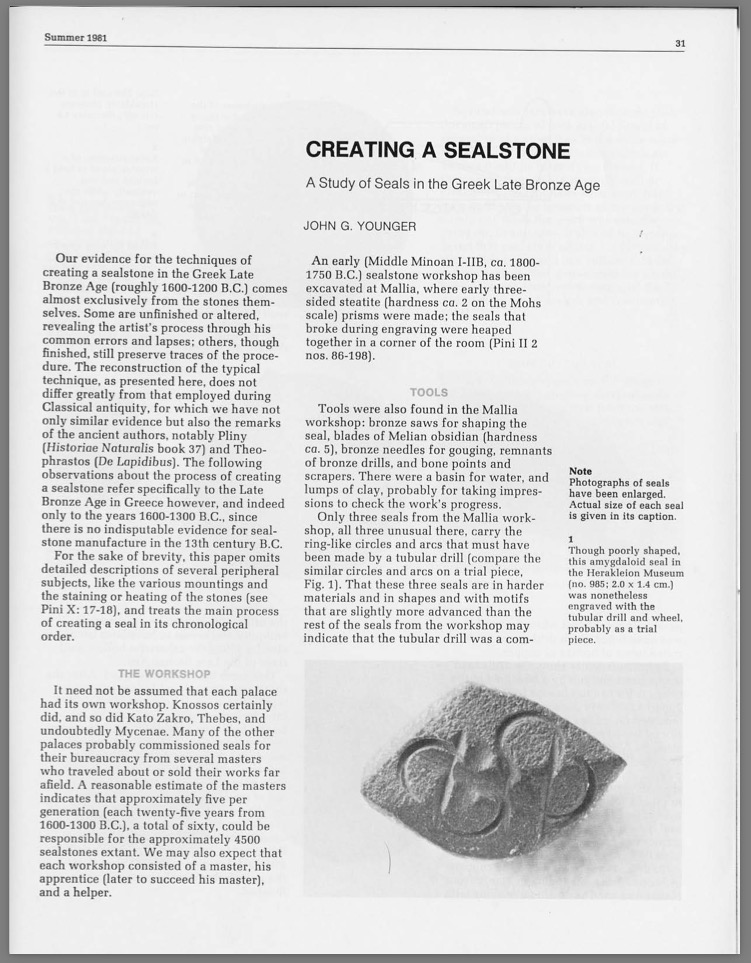
Our evidence for the techniques of creating a sealstone in the Greek Late Bronze Age (roughly 1600-1200 B.C.) comes almost exclusively from the stones themselves. Some are unfinished or altered, revealing the artist’s process through his common errors and lapses; others, though finished, still preserve traces of the procedure. The reconstruction of the typical technique, as presented here, does not differ greatly from that employed during Classical antiquity, for which we have not only similar evidence but also the remarks of the ancient authors, notably Pliny (Historiae Naturalis book 37) and Theophrastos (De Lapidibus). The following observations about the process of creating a sealstone refer specifically to the Late Bronze Age in Greece however, and indeed only to the years 1600-1300 B.C., since there is no indisputable evidence for seal-stone manufacture in the 13th century B.C. For the sake of brevity, this paper omits detailed descriptions of several peripheral subjects, like the various mountings and the staining or heating of the stones (see Pini X: 17-18), and treats the main process of creating a seal in its chronological order.