
Four Treasures Reference Database
Record No. 26663
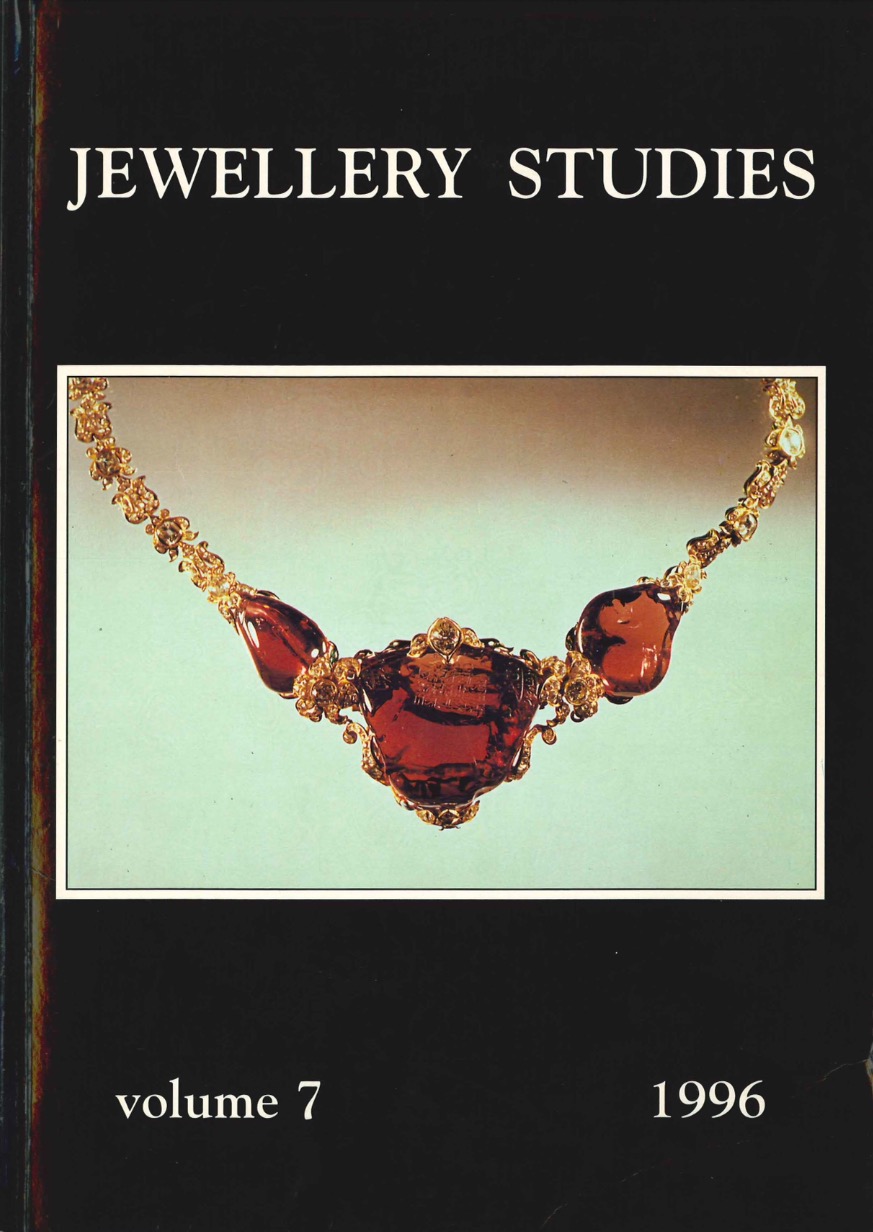
Work of thorns
Journal Article
Farmer, V. (1996) Work of thorns. Jewellery Studies, Vol. 7, pp. 13–36.
Sinkankas/Born No.: NIS/NIB | RWHL*
gems, ancient gemology, ancient jewelry, India, Indian jewelry, Acacia Arabica
This research project is a technical study of a specific Indian jewellery technique known as “babul” work—named after the flower of the Acacia Arabica—or “khardar.” The study focuses on a group of jewellery pieces from 1850s Delhi, now part of the V&A’s Indian collection, and draws comparisons with several near-contemporary literary sources. The technique is typically applied to gold, though one silver piece is included in the group. The report opens with a discussion of gold, gold alloys, and solders based on an 1890 government publication, while the babul technique itself is described in a slightly earlier source. The technique is analyzed both through these texts and by direct examination of the jewellery using light and electron microscopy. These investigations were further supported by practical experiments attempting to recreate the technique in silver and gold. Microscopic examination revealed that the babul work studied had actually been executed using two distinct techniques, though only one is documented in existing literature. Attempts to replicate the undocumented method were informative but inconclusive, indicating potential for further research. However, reproduction of the documented technique was highly successful and provided additional insight into this traditional craft.