
Four Treasures Reference Database
Record No. 26667
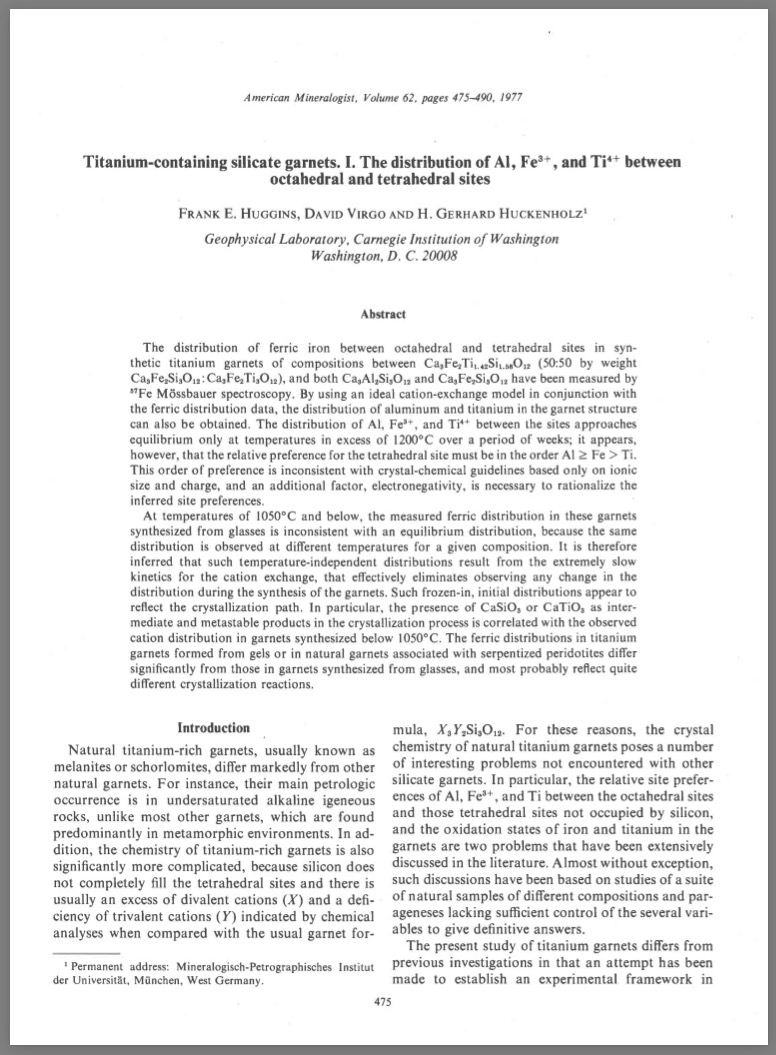
Titanium-containing silicate garnets. I. The distribution of Al, Fe³⁺, and Ti⁴⁺ between octahedral and tetrahedral sites
Journal Article
Huggins, F.E., Virgo, D. and Huchenholz, H.G. (1977) Titanium-containing silicate garnets. I. The distribution of Al, Fe³⁺, and Ti⁴⁺ between octahedral and tetrahedral sites. American Mineralogist, Vol. 62, Nos. 5–6, May–June, pp. 475–490.
RWHL
Close Abstract
Hide Keywords
Copy Reference
gems, garnet, titanium garnet
The distribution of ferric iron between octahedral and tetrahedral sites in synthetic titanium garnets of compositions between Ca₉Fe₂Ti₁.₄₂Si₁.₅₈O₁₂ (50:50 by weight Ca₃Fe₂Si₃O₁₂: Ca₃Fe₂Ti₃O₁₂), and both Ca₃Al₂Si₃O₁₂ and Ca₃Fe₂Si₃O₁₂ have been measured by ⁵⁷Fe Mössbauer spectroscopy. By using an ideal cation-exchange model in conjunction with the ferric distribution data, the distribution of aluminum and titanium in the garnet structure can also be obtained. The distribution of Al, Fe³⁺, and Ti⁴⁺ between the sites approaches equilibrium only at temperatures in excess of 1200°C over a period of weeks; it appears, however, that the relative preference for the tetrahedral site must be in the order Al ≥ Fe > Ti. This order of preference is inconsistent with crystal-chemical guidelines based only on ionic size and charge, and an additional factor, electronegativity, is necessary to rationalize the inferred site preferences. At temperatures of 1050°C and below, the measured ferric distribution in these garnets synthesized from glasses is inconsistent with an equilibrium distribution, because the same distribution is observed at different temperatures for a given composition. It is therefore inferred that such temperature-independent distributions result from the extremely slow kinetics for the cation exchange, that effectively eliminates observing any change in the distribution during the synthesis of the garnets. Such frozen-in, initial distributions appear to reflect the crystallization path. In particular, the presence of CaSiO₃ or CaTiO₃ as intermediate and metastable products in the crystallization process is correlated with the observed cation distribution in garnets synthesized below 1050°C. The ferric distributions in titanium garnets formed from gels or in natural garnets associated with serpentized peridotites differ significantly from those in garnets synthesized from glasses, and most probably reflect quite different crystallization reactions.