
Four Treasures Reference Database
Record No. 26671
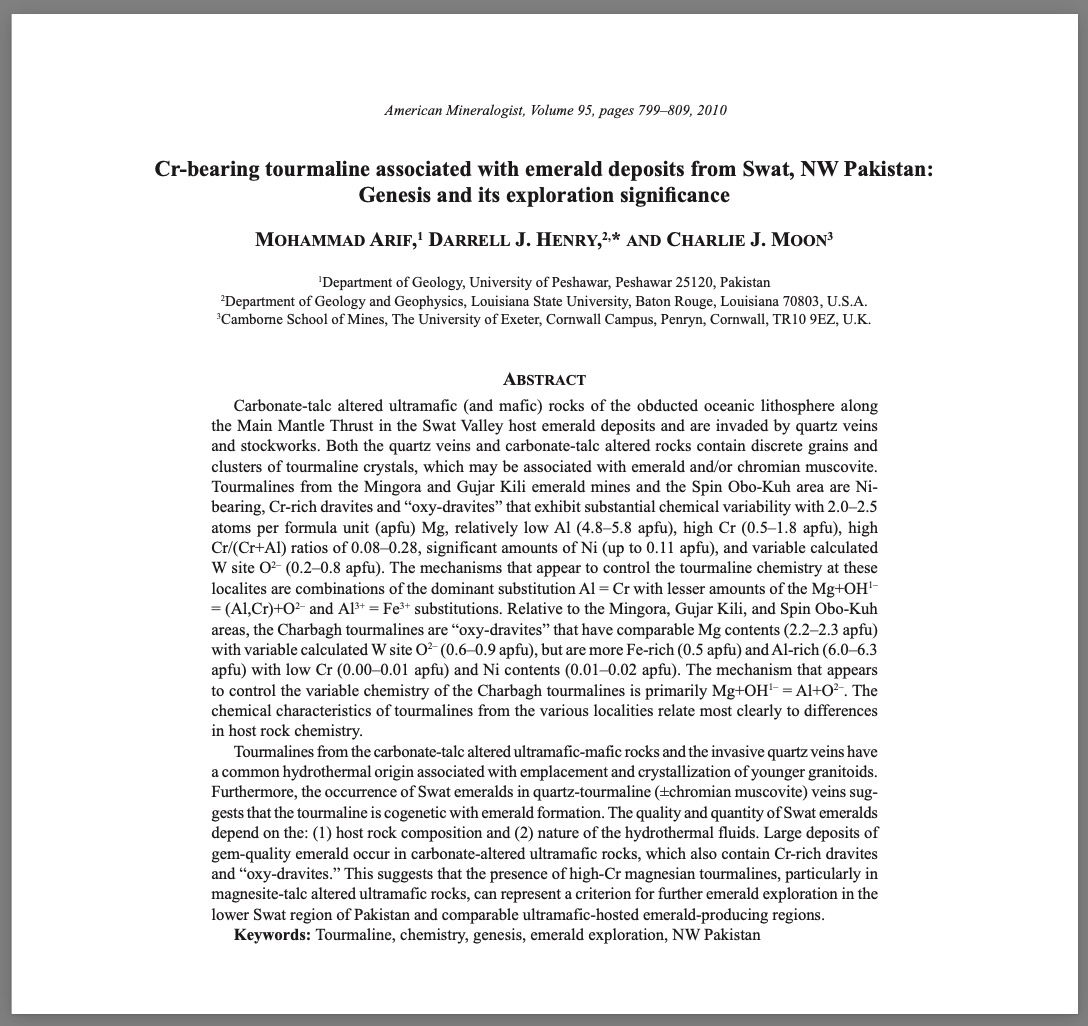
Cr-bearing tourmaline associated with emerald deposits from Swat, NW Pakistan: Genesis and it exploration significance
Journal Article
Arif, M., Henry, D.J. and Moon, C.J. (2010) Cr-bearing tourmaline associated with emerald deposits from Swat, NW Pakistan: Genesis and it exploration significance. American Mineralogist, Vol. 95, No. 5–6, May–June, pp. 799–809.
Close Abstract
Hide Keywords
Copy Reference
gems, beryl, emerald, Pakistan, Swat, tourmaline, chrome tourmaline, emerald geology
Carbonate–talc altered ultramafic and mafic rocks of the obducted oceanic lithosphere along the Main Mantle Thrust in the Swat Valley host emerald deposits and are crosscut by quartz veins and stockworks. Both the quartz veins and the altered rocks contain discrete grains and clusters of tourmaline crystals, often associated with emerald and/or chromian muscovite. Tourmalines from the Mingora and Gujar Kili emerald mines and the Spin Obo-Kuh area are Ni-bearing, Cr-rich dravites and “oxy-dravites” showing considerable chemical variability, with 2.0–2.5 atoms per formula unit (apfu) Mg, relatively low Al (4.8–5.8 apfu), high Cr (0.5–1.8 apfu), high Cr/(Cr+Al) ratios (0.08–0.28), significant Ni content (up to 0.11 apfu), and variable calculated W site O²⁻ (0.2–0.8 apfu). The dominant chemical controls appear to be the substitutions Al = Cr, Mg+OH⁻ = (Al,Cr)+O²⁻, and Al³⁺ = Fe³⁺. In contrast, tourmalines from the Charbagh area are also “oxy-dravites” but have higher Fe (0.5 apfu) and Al (6.0–6.3 apfu) and lower Cr (0.00–0.01 apfu) and Ni (0.01–0.02 apfu), with comparable Mg (2.2–2.3 apfu) and variable W site O²⁻ (0.6–0.9 apfu); their composition is primarily controlled by the Mg+OH⁻ = Al+O²⁻ substitution. These chemical variations correlate with differences in host rock composition. All tourmalines, whether from the altered ultramafic-mafic rocks or quartz veins, share a hydrothermal origin linked to the emplacement and crystallization of younger granitoids. The occurrence of Swat emeralds in quartz–tourmaline (±chromian muscovite) veins indicates a cogenetic relationship between tourmaline and emerald. The quality and abundance of Swat emeralds are determined primarily by the composition of the host rock and the nature of the hydrothermal fluids. Large, gem-quality emerald deposits occur in carbonate-altered ultramafic rocks that also host Cr-rich dravites and “oxy-dravites,” suggesting that the presence of high-Cr magnesian tourmalines, particularly in magnesite–talc altered ultramafic settings, may serve as a valuable exploration indicator for emeralds in the lower Swat region of Pakistan and comparable ultramafic-hosted emerald districts.