
Four Treasures Reference Database
Record No. 26673
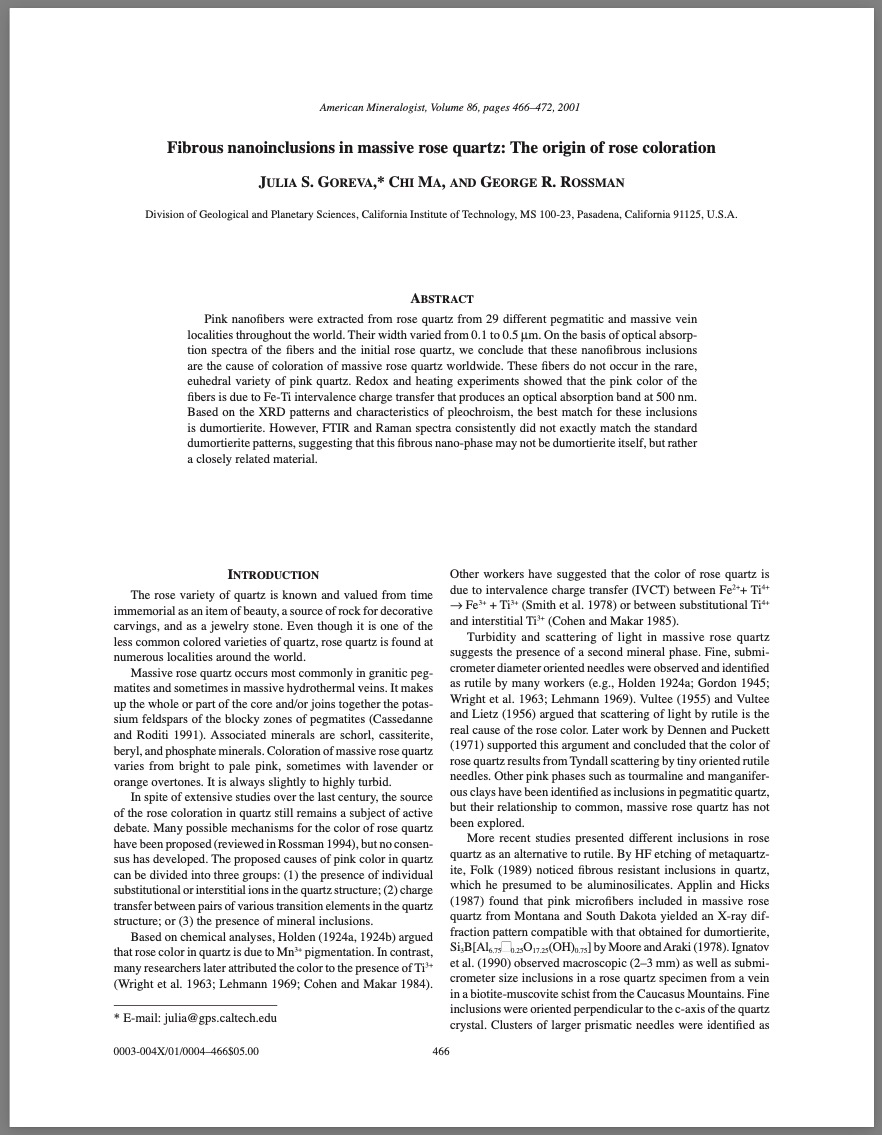
Fibrous nanoinclusions in massive rose quartz: The origin of rose coloration
Journal Article
Goreva, J.S., Ma, C. and Rossman, G.R. (2001) Fibrous nanoinclusions in massive rose quartz: The origin of rose coloration. American Mineralogist, Vol. 86, No. 4, April, pp. 466–472.
Sinkankas/Born No.: NIS/NIB | RWHL
gems, quartz, rose quartz, inclusions, fiber inclusions, silk, dumortierite, analytical
Pink nanofibers were extracted from rose quartz samples collected from 29 pegmatitic and massive vein localities worldwide, with fiber widths ranging from 0.1 to 0.5 µm. Optical absorption spectra of both the nanofibers and the original rose quartz indicate that these nanofibrous inclusions are responsible for the coloration of massive rose quartz globally. Notably, such fibers are absent in the rare, euhedral variety of pink quartz. Redox and heating experiments revealed that the pink color arises from Fe-Ti intervalence charge transfer, which generates an optical absorption band at 500 nm. X-ray diffraction patterns and pleochroic behavior suggest that the inclusions are most similar to dumortierite; however, FTIR and Raman spectra show consistent deviations from standard dumortierite signatures, implying that the fibrous nanophase may not be dumortierite itself but a closely related mineral species.