
Four Treasures Reference Database
Record No. 26674
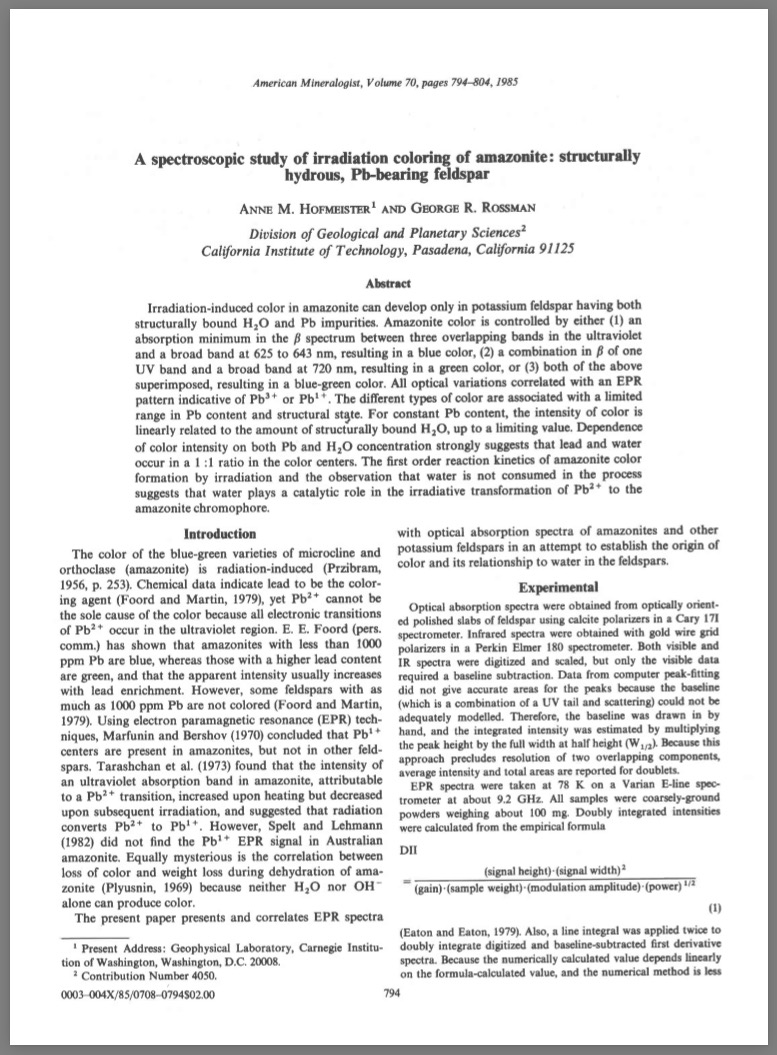
A spectroscopic study of irradiation coloring of amazonite: Structurally hydrous, Pb-bearing feldspar
Journal Article
Hofmeister, A.M. and Rossman, G.R. (1985) A spectroscopic study of irradiation coloring of amazonite: Structurally hydrous, Pb-bearing feldspar. American Mineralogist, Vol. 70, Nos. 7–8, July–August, pp. 794–804.
Sinkankas/Born No.: NIS/NIB | RWHL
gems, feldspar, microcline, amazonite
Irradiation-induced color in amazonite develops only in potassium feldspar that contains both structurally bound H₂O and lead (Pb) impurities. The coloration is governed by distinct optical absorption behaviors: (1) a blue color arises from an absorption minimum in the π spectrum between three overlapping ultraviolet bands and a broad band at 625–643 nm; (2) a green color results from a combination of one UV band and a broad band at 720 nm; and (3) a blue-green color occurs when both features are superimposed. All color variations correlate with an EPR signal indicative of Pb³⁺ or Pb²⁺. These color types are associated with a narrow range of Pb content and specific structural states, and for a fixed Pb concentration, the intensity of color increases linearly with the amount of structurally bound H₂O, up to a saturation point. The dependence of color intensity on both Pb and H₂O concentrations strongly suggests a 1:1 ratio of lead to water in the color centers. The first-order kinetics of amazonite color formation via irradiation, combined with the observation that water is not consumed during the process, indicate that H₂O acts catalytically in the transformation of Pb²⁺ into the chromophore responsible for amazonite’s distinctive color.