
Four Treasures Reference Database
Record No. 26675
EPR of [Pb–Pb]³⁺ mixed valence pairs in amazonite-type microcline
Journal Article
Petrov, I., Mineeva, R.M., Bershov, L.V. and Agel, A. (1993) EPR of [Pb–Pb]³⁺ mixed valence pairs in amazonite-type microcline. American Mineralogist, Vol. 78, pp. 500–510.
Sinkankas/Born No.: NIS/NIB | RWHL
gems, feldspar, microcline, amazonite, cause of color
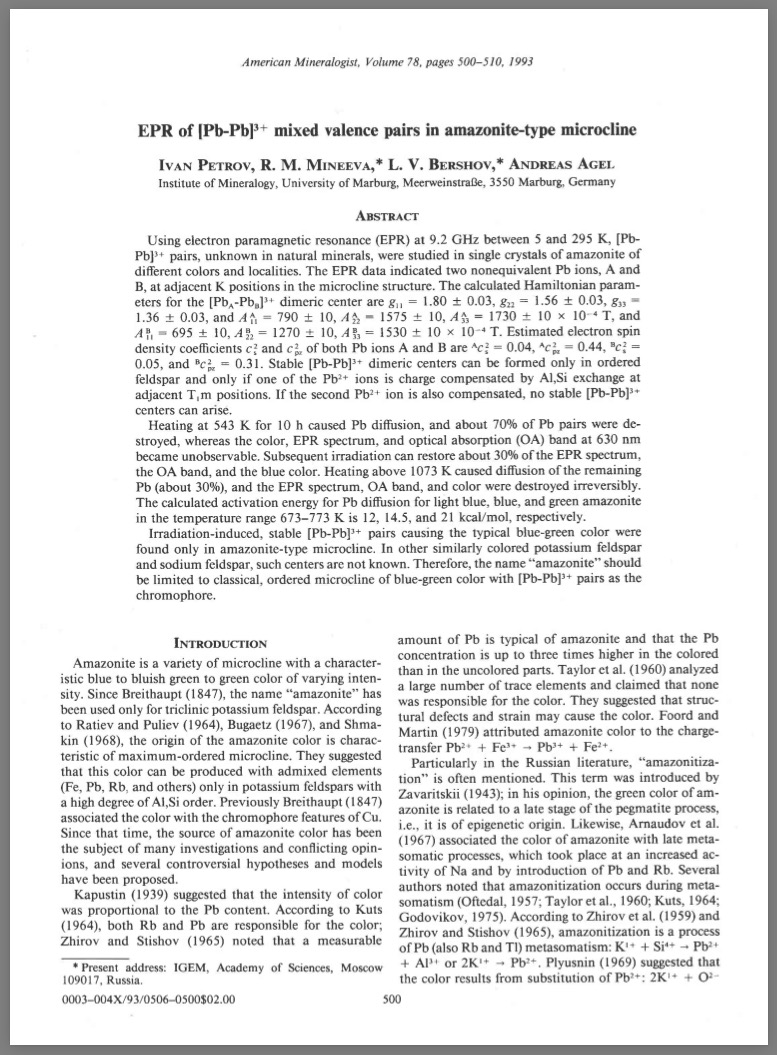
Using electron paramagnetic resonance (EPR) at 9.2 GHz between 5 and 295 K, [Pb–Pb]³⁺ pairs—previously unknown in natural minerals—were studied in single crystals of amazonite from various localities and color grades. EPR data revealed two nonequivalent Pb ions, A and B, occupying adjacent K sites within the microcline structure. The calculated Hamiltonian parameters for the [Pbᴬ–Pbᴮ]³⁺ dimeric center are g∥ = 1.80 ± 0.03, g⊥ = 1.56 ± 0.03, gᶻ = 1.36 ± 0.03, with hyperfine constants A∥ = 790 ± 10, A⊥ = 1575 ± 10, Aᶻ = 1730 ± 10 × 10⁻⁴ T for Pbᴬ, and A∥ = 695 ± 10, A⊥ = 1270 ± 10, Aᶻ = 1530 ± 10 × 10⁻⁴ T for Pbᴮ. Estimated electron spin density coefficients were c∥ = 0.04, c⊥ = 0.44 for Pbᴬ and c∥ = 0.05, c⊥ = 0.31 for Pbᴮ. Stable [Pb–Pb]³⁺ centers can form only in ordered feldspar, and only if one Pb²⁺ ion is charge-compensated by an Al,Si exchange at adjacent Tₘ positions; if both are compensated, the dimeric center is unstable. Heating at 543 K for 10 hours led to Pb diffusion and destroyed about 70% of the Pb pairs, eliminating the characteristic color, EPR signal, and optical absorption (OA) band at 630 nm. Subsequent irradiation restored roughly 30% of the EPR signal, OA band, and blue color. Heating above 1073 K caused complete Pb diffusion and irreversible loss of color and spectral features. The calculated activation energies for Pb diffusion in light blue, blue, and green amazonite are 12, 14.5, and 21 kcal/mol, respectively, within the 673–773 K range. Irradiation-induced, stable [Pb–Pb]³⁺ pairs responsible for amazonite’s characteristic blue-green color were found only in amazonite-type microcline; such centers are not present in similarly colored potassium or sodium feldspars. Therefore, the name “amazonite” should be reserved for ordered, blue-green microcline feldspar containing [Pb–Pb]³⁺ chromophores.