
Four Treasures Reference Database
Record No. 26689
Gem News International: Demantoid garnet from Iran
Journal Article
Laurs, B.M. (2002) Gem News International: Demantoid garnet from Iran. Gems & Gemology, Vol. 38, No. 1, Spring, p. 96.
Sinkankas/Born No.: NIS/NIB | RWHL
gems, garnet, andradite, demantoid, demantoid, Iran
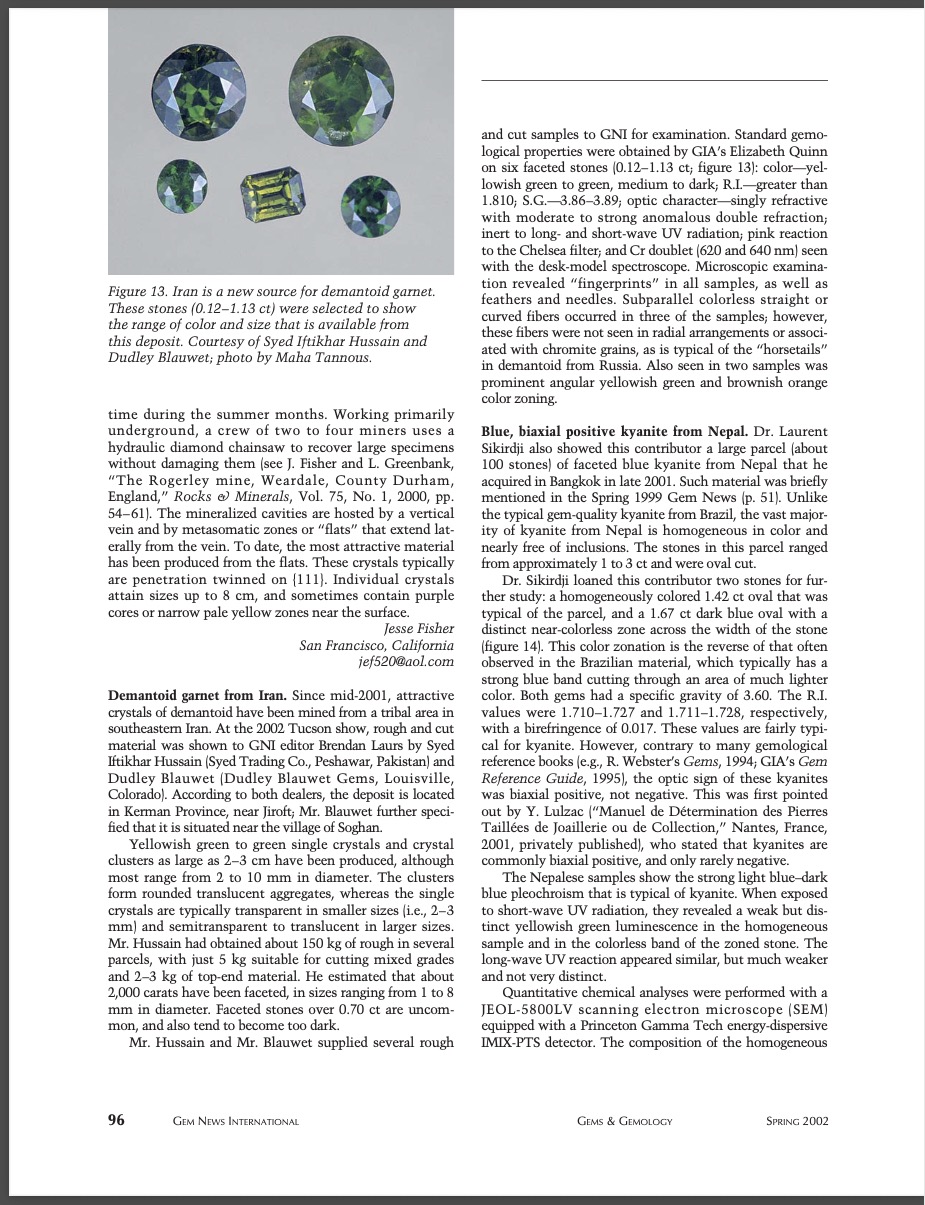
Demantoid garnet from Iran: Since mid-2001, attractive crystals of demantoid have been mined from a tribal area in southeastern Iran. At the 2002 Tucson show, rough and cut material was shown to GNI editor Brendan Laurs by Syed Iftikhar Hussain (Syed Trading Co., Peshawar, Pakistan) and Dudley Blauwet (Dudley Blauwet Gems, Louisville, Colorado). According to both dealers, the deposit is located in Kerman Province, near Jiroft; Mr. Blauwet further specified that it is situated near the village of Soghan. Yellowish green to green single crystals and crystal clusters as large as 2–3 cm have been produced, although most range from 2 to 10 mm in diameter. The clusters form rounded translucent aggregates, whereas the single crystals are typically transparent in smaller sizes (2–3 mm) and semitransparent to translucent in larger sizes. Mr. Hussain had obtained about 150 kg of rough in several parcels, with just 5 kg suitable for cutting mixed grades and 2–3 kg of top-end material. He estimated that about 2,000 carats have been faceted, in sizes ranging from 1 to 8 mm in diameter, with faceted stones over 0.70 ct being uncommon and tending to become too dark. Mr. Hussain and Mr. Blauwet supplied several rough and cut samples to GNI for examination. Standard gemological properties were obtained by GIA’s Elizabeth Quinn on six faceted stones (0.12–1.13 ct): color—yellowish green to green, medium to dark; refractive index—greater than 1.810; specific gravity—3.86–3.89; optic character—singly refractive with moderate to strong anomalous double refraction; inert to long- and short-wave UV radiation; pink reaction to the Chelsea filter; and Cr doublet (620 and 640 nm) seen with the desk-model spectroscope. Microscopic examination revealed fingerprints in all samples, as well as feathers and needles. Subparallel colorless straight or curved fibers were seen in three of the samples, though not in radial arrangements or associated with chromite grains as in Russian demantoids, and two samples displayed prominent angular yellowish green and brownish orange color zoning.