
Four Treasures Reference Database
Record No. 26692
Fingerprinting gem beryl samples using laser-induced breakdown spectroscopy (LIBS) and portable X-ray fluorescence (PXRF)
Journal Article
McMillan, N.J., McManus, C.E., Gomez, T.L., Harmon, R.S., DeLucia, F.C. and Miziolek, A.W. (2006) Fingerprinting gem beryl samples using laser-induced breakdown spectroscopy (LIBS) and portable X-ray fluorescence (PXRF). Gems & Gemology, Vol. 42, No. 3, Fall, p. 126.
RWHL
gems, beryl, aquamarine, LIBS analysis
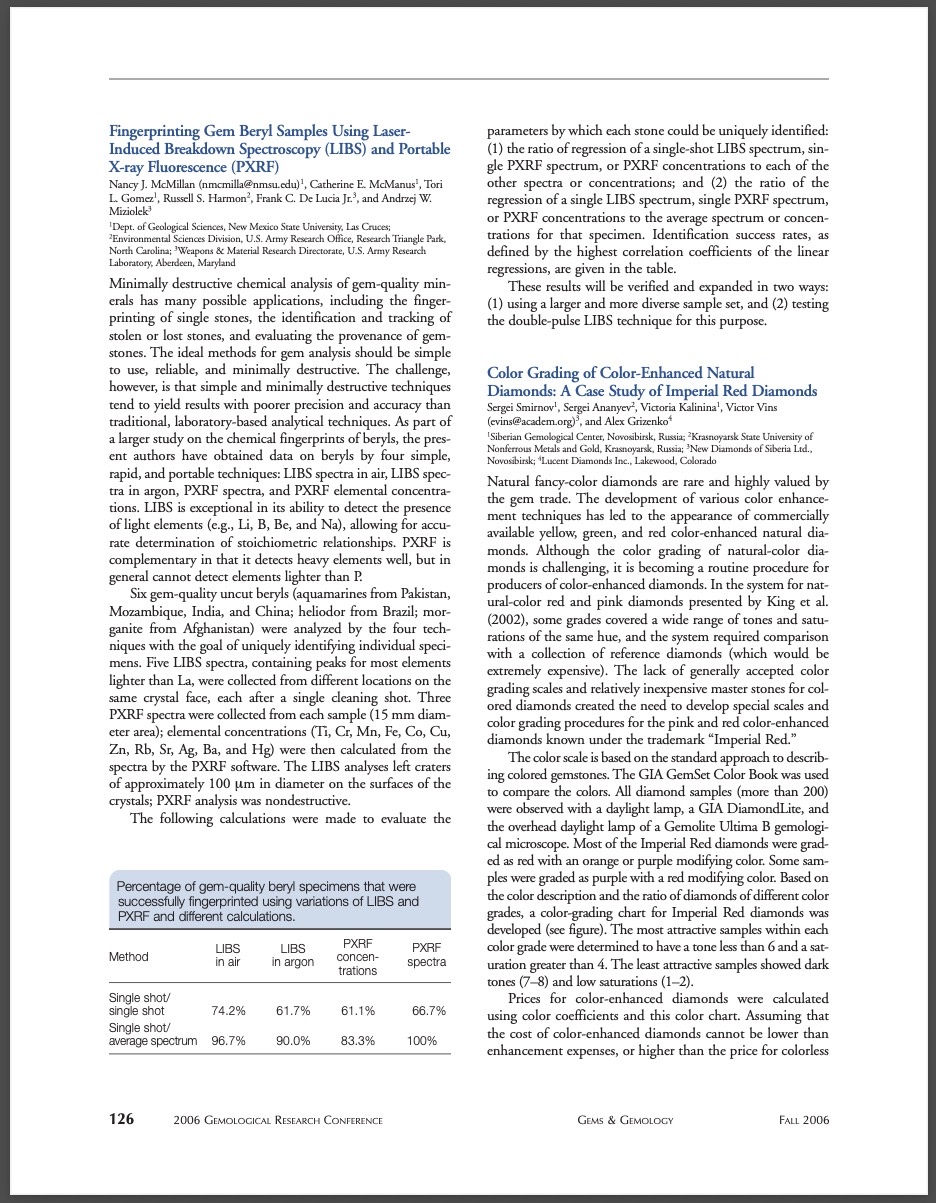
Minimally destructive chemical analysis of gem-quality minerals has broad applications, such as fingerprinting individual stones, identifying stolen or lost gems, and evaluating their provenance. Ideal analytical methods should be simple, reliable, and minimally invasive, though such techniques often sacrifice precision and accuracy compared to traditional lab-based methods. In a broader study of chemical fingerprints in beryl, the authors applied four rapid and portable techniques: LIBS (laser-induced breakdown spectroscopy) in air and in argon, as well as PXRF (portable X-ray fluorescence) spectra and PXRF-derived elemental concentrations. LIBS is particularly effective at detecting light elements such as Li, B, Be, and Na—useful for determining stoichiometry—while PXRF excels at detecting heavier elements but generally cannot identify those lighter than phosphorus. The study analyzed six uncut gem beryls (aquamarines from Pakistan, Mozambique, India, and China; heliodor from Brazil; and morganite from Afghanistan) using these methods to evaluate whether individual specimens could be uniquely identified. For each sample, five LIBS spectra were collected from different points on the same crystal face after a single cleaning shot, capturing elements lighter than lanthanum, while PXRF collected three spectra per sample over a 15 mm area, and calculated concentrations of Ti, Cr, Mn, Fe, Co, Cu, Zn, Rb, Sr, Ag, Ba, and Hg. LIBS created ~100 µm craters on crystal surfaces, while PXRF was entirely nondestructive.