
Four Treasures Reference Database
Record No. 26721
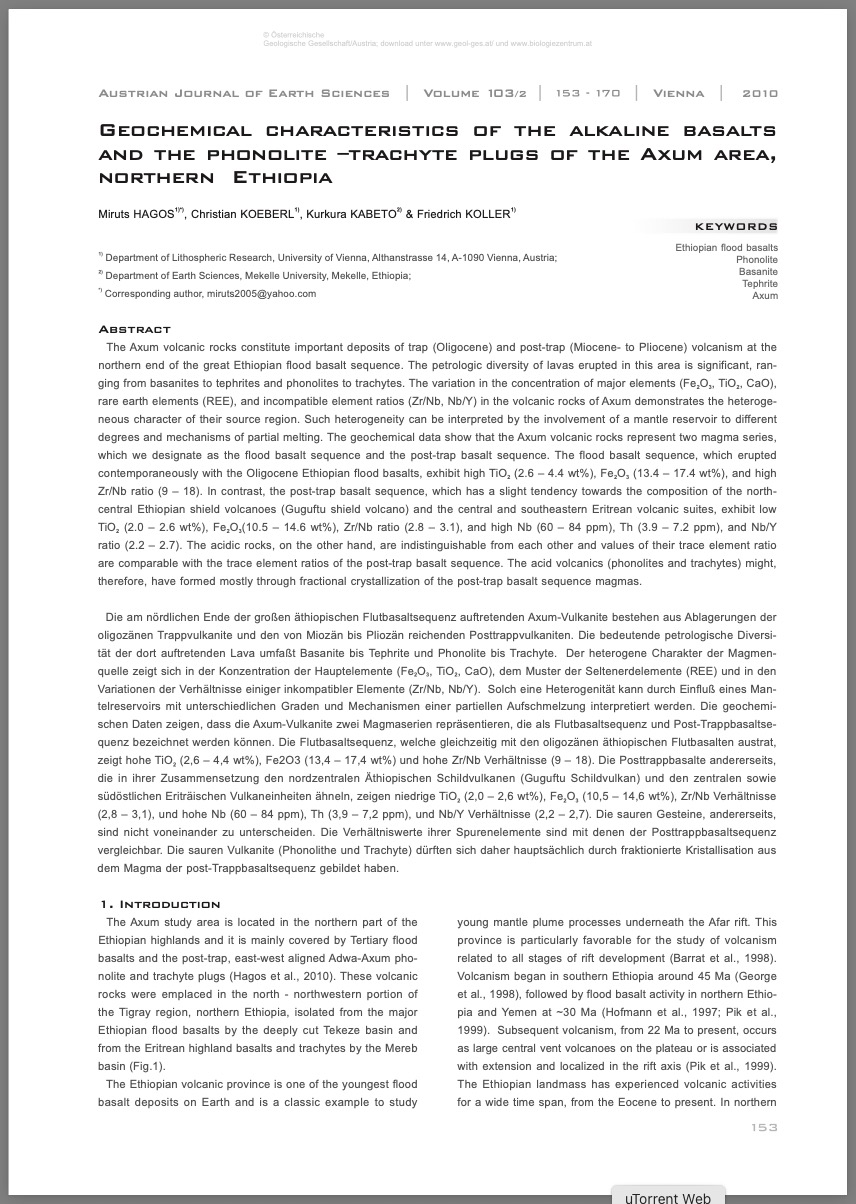
Geochemical characteristics of the alkaline basalts and the phonolite-trachyte plugs of the Axum area, northern Ethiopia
Journal Article
Hagos, M., Koeberl, C., Kabeto, K. and Koller, F. (2010) Geochemical characteristics of the alkaline basalts and the phonolite-trachyte plugs of the Axum area, northern Ethiopia. Austrian Journal of Earth Sciences, Vol. 103, No. 2, pp. 153–170.
Sinkankas/Born No.: NIS/NIB | RWHL
gems, corundum, Ethiopia.12, sapphire
The Axum volcanic rocks represent significant deposits of both trap (Oligocene) and post-trap (Miocene–Pliocene) volcanism at the northern terminus of the Ethiopian flood basalt province. These volcanic rocks display considerable petrological diversity, including basanites, tephrites, phonolites, and trachytes. Variations in the concentrations of major oxides (Fe₂O₃, TiO₂, CaO), rare earth elements (REE), and incompatible element ratios (such as Zr/Nb and Nb/Y) highlight the heterogeneous nature of the source region, which reflects differing degrees and mechanisms of partial melting involving a mantle reservoir. Geochemical data reveal two distinct magma series: the flood basalt sequence and the post-trap basalt sequence. The flood basalts, contemporaneous with the broader Oligocene Ethiopian flood basalts, are characterized by high TiO₂ (2.6–4.4 wt%), Fe₂O₃ (13.4–17.4 wt%), and Zr/Nb ratios (9–18). In contrast, the post-trap basalts trend toward compositions seen in the north-central Ethiopian shield volcanoes (e.g., Guguftu) and volcanic suites of central and southeastern Eritrea, and exhibit lower TiO₂ (2.0–2.6 wt%), Fe₂O₃ (10.5–14.6 wt%), and Zr/Nb ratios (2.8–3.1), alongside higher Nb (60–84 ppm), Th (3.9–7.2 ppm), and Nb/Y ratios (2.2–2.7). The acidic volcanic rocks (phonolites and trachytes) show trace element ratios similar to those of the post-trap basalts and likely formed through fractional crystallization of post-trap basaltic magmas.