
Four Treasures Reference Database
Record No. 26735
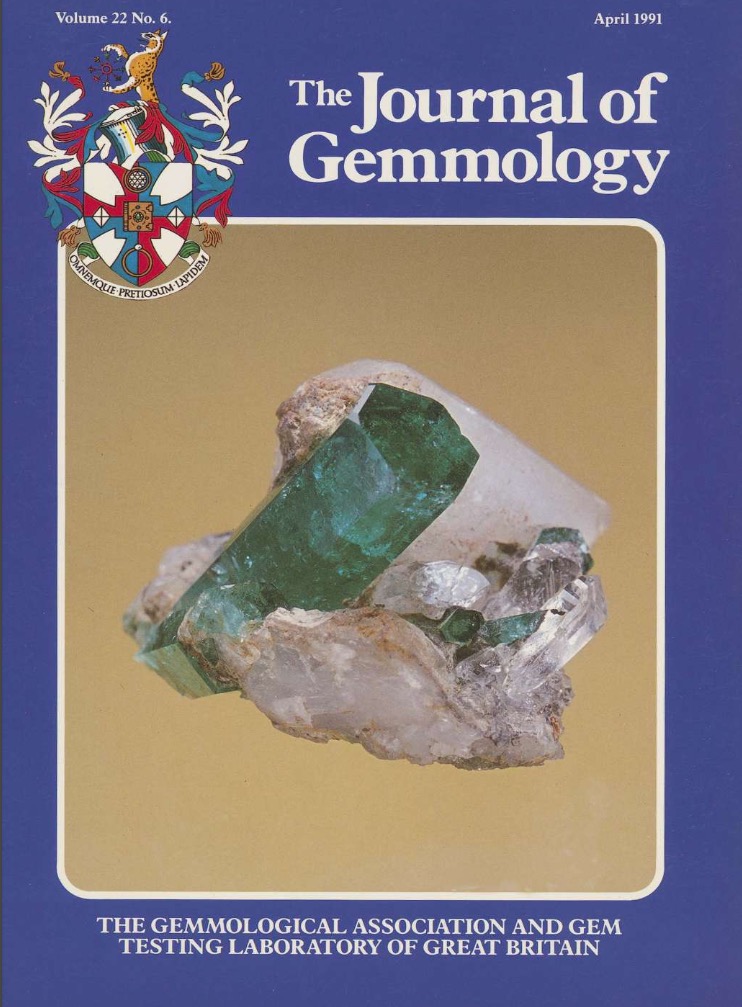
Emeralds of Colombia, (Part 1)
Journal Article
Bosshart, G. (1991) Emeralds of Colombia, (Part 1). Journal of Gemmology, Vol. 22, No. 6, April, pp. 355–361.
ISBN/ISSN: 221252 | Sinkankas/Born No.: NIS/NIB | RWHL*
gems, beryl, emerald, Colombia
A condensed historical and mining survey is followed by a compilation of the most notable crystals of Colombian emeralds ever found and of the details of their chemical composition. A summary of the elemental substitutions and their effects on the outlined range of gemmological data is given. Special emphasis is placed on the cause of the famous, vividly green coloration, i.e. on the selective absorption of orange-red and violet light, dictated by minor contents of the chromophoric elements Cr and V substituting for Al³⁺ in octahedrally coordinated sites of the beryl lattice (Cr ≈ V, with the Cr/V ratio found to be ranging from 4.5 to 0.5, in extreme cases from about 10 to 0.1). Iron, however, has barely been detected in the UV/VIS absorption spectra of Colombian emeralds. Though generally present in slightly larger amounts than Cr³⁺, iron does not recognizably influence the colour (little Fe²⁺ and possibly some Fe³⁺ positioned in the axial channels of the ring-silicate structure). A detailed presentation of the currently known internal characteristics (inclusions and growth structures) is supplemented by a discussion of identification problems with treated emeralds and the disclosure of the treatment during transactions in the wholesale and retail trade. Allocation of the emeralds to individual Colombian mines on the basis of inclusion patterns does not appear possible in most instances. However, the differentiation of Colombian emeralds from other natural emeralds (such as those from the Panjsher Valley exhibiting very similar (s,l,g) three-phase inclusions) or from difficult, modern hydrothermal and flux synthetics is shown to be feasible by a combination of microscopy, refractometry, and absorption spectrometry (UV/VIS and NIR/MIR), assisted by chemical analysis only in the most difficult cases. Safe identification of authenticity, treatment, and origin of emeralds, however, is increasingly becoming the task of the experts in the specialized laboratory. The mineralogical definition of emerald as a yellowish to bluish-green variety of natural beryl is shown to be valid for any Cr and V-containing variety except possibly the rare, absolutely chromium-free (V,Fe)-beryls (modification of the former definition of type II emerald): in many of the preferred Colombian emeralds, chromium is clearly dominated by vanadium (Cr/V ratio < 1). However, chromium has a higher efficiency of coloration than vanadium and a much higher one than iron ions in the various substitutional and interstitial lattice sites of beryl. Cr influences colour even at very low trace levels. An extensive and up-dated selection of literature, covering all aspects cited, completes the synopsis.