
Four Treasures Reference Database
Record No. 26836
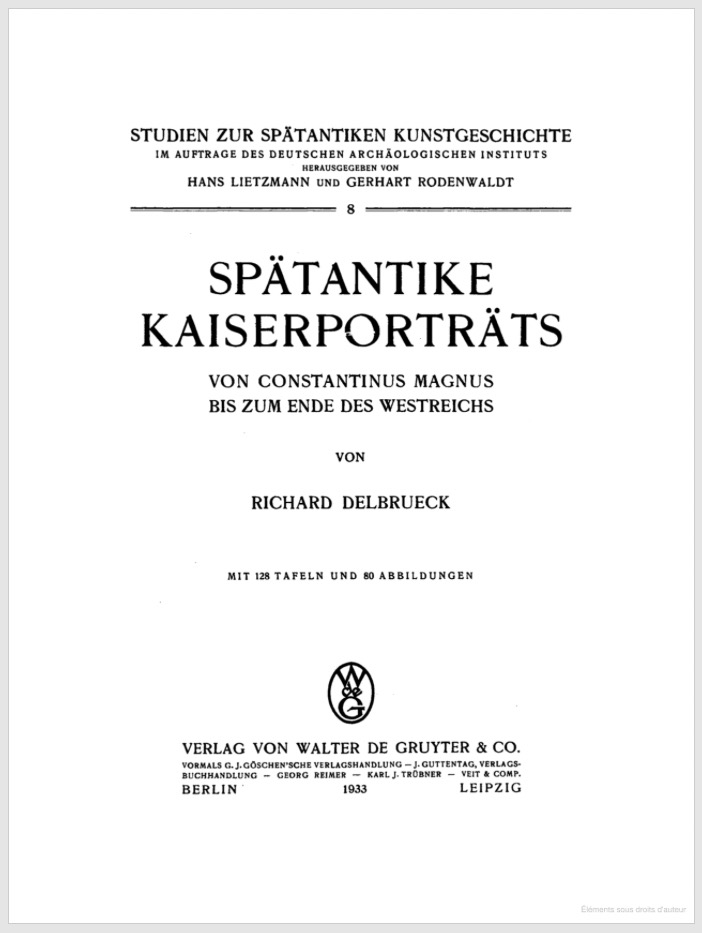
Spätantike Kaiserporträts: Von Constantius Magnus Bis Zum Ende Des Westreichs
Late Antique Imperial Portraits: From Constantius Magnus to the End of the Western Empire
Edited Book
Delbrück, R., editor (1933) Spätantike Kaiserporträts: Von Constantius Magnus Bis Zum Ende Des Westreichs. [Late Antique Imperial Portraits: From Constantius Magnus to the End of the Western Empire]. Berlin, Walter de Gruyter, 272 pp.. reprinted 1978.
ISBN/ISSN: 9783110000000 | Sinkankas/Born No.: NIS/NIB | Language: in German | not seen
Close Abstract
Hide Keywords
Copy Reference
gems, glyptic, engraved gems, agate, cameo, intaglio
After studying the dawn of Roman art in a foundational work on the history of architecture (Hellenistische Bauten in Latium, 1907–1912), and exploring iconography through Antike Porträts (1912) and Bildnisse römischer Kaiser (1914), Richard Delbrueck turned his attention to its twilight. Under the auspices of the German Archaeological Institute’s collection on late or lingering antiquity, he published within a decade three lavish volumes: Die Consulardiptychen und verwandte Denkmäler (from 1926), Antike Porphyrwerke (1932), and the present volume, which gathers portraits of Augusti, Caesars, and empresses from Constantine’s reign to the fall of the Western Empire. The coin effigies on the first twenty-five plates serve as a narrative thread and also illustrate the difficulty of accurate identification. As Delbrueck notes (p. 9), imperial portraits are always tendentious; each emperor constructs a vision of majesty not by merely idealizing his features, but by emulating a recent or ancient illustrious model. “Generally, a son adopts his father’s portrait when the latter ruled, and only slowly—if at all—develops his own individuality. This already contributes, despite differences, to the familial resemblance among the princes of Constantine’s house. An unrelated predecessor may exert the same influence: the portraits of Constantius II, Theodosius II, and Valentinian III clearly inspired those of their successors. Usurpers readily borrow the features of the legitimate emperor… When there are multiple sons, the younger imitate both their father and eldest brother… Some princes also drew inspiration from great figures of the past: Constantine, for example, from his supposed ancestor Claudius Gothicus, even more from Augustus, and perhaps from Alexander… When several of these factors act simultaneously—as often happens—the same emperor may be represented by several equally official portrait types.”