
Four Treasures Reference Database
Record No. 26838
A study of chalcedony
Journal Article
Pelto, C.R. (1956) A study of chalcedony. American Journal of Science, Vol. 254, pp. 32–50.
gems, quartz, agate, chalcedony, opal, silica
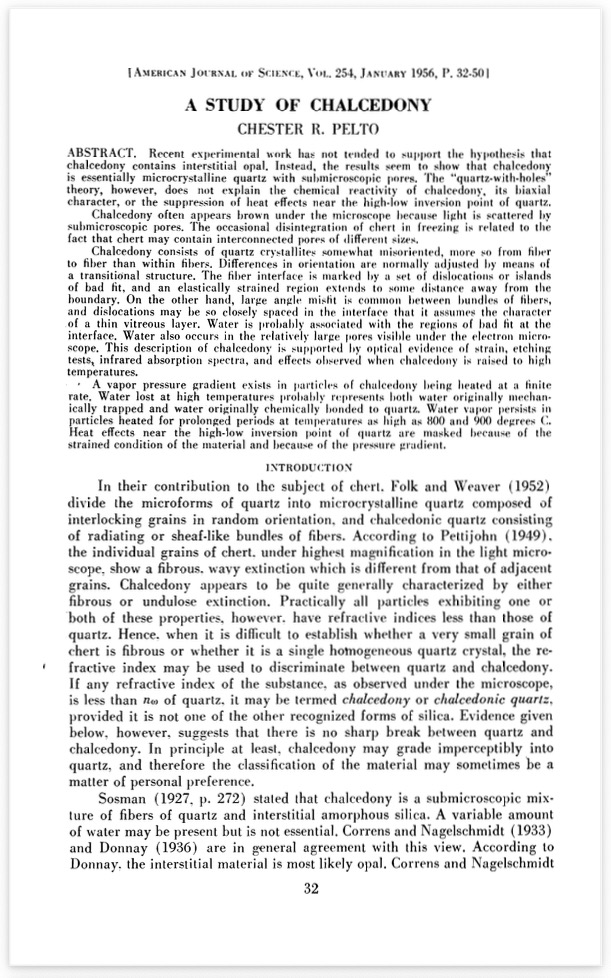
Recent experimental studies do not support the earlier hypothesis that chalcedony contains interstitial opal; instead, findings indicate that it is primarily microcrystalline quartz with submicroscopic pores. This “quartz-with-holes” model, however, fails to account for chalcedony’s chemical reactivity, biaxial optical character, or the suppression of thermal effects near the quartz high-low inversion point. Under the microscope, chalcedony often appears brown due to light scattering by these tiny pores, and the disintegration of chert under freezing conditions is attributed to networks of differently sized interconnected pores. Structurally, chalcedony is composed of quartz crystallites with slight misorientation—more pronounced between fibers than within them. These orientation mismatches are bridged by transitional zones marked by dislocations or poorly fitted regions, which are elastically strained and may extend over some distance. Between bundles of fibers, large-angle mismatches can create densely packed dislocations, producing interfaces that resemble thin vitreous layers, often associated with water. Water is also present in the larger pores observable via electron microscopy. This structural interpretation is supported by optical strain patterns, etching behavior, infrared spectroscopy, and thermal studies. When heated, chalcedony exhibits a vapor pressure gradient, and the water released likely includes both mechanically trapped and chemically bonded forms. Thermal anomalies near the quartz inversion temperature are obscured by internal strain and the evolving pressure gradient. [RWH: This theory has not proven to be true]