
Four Treasures Reference Database
Record No. 26854
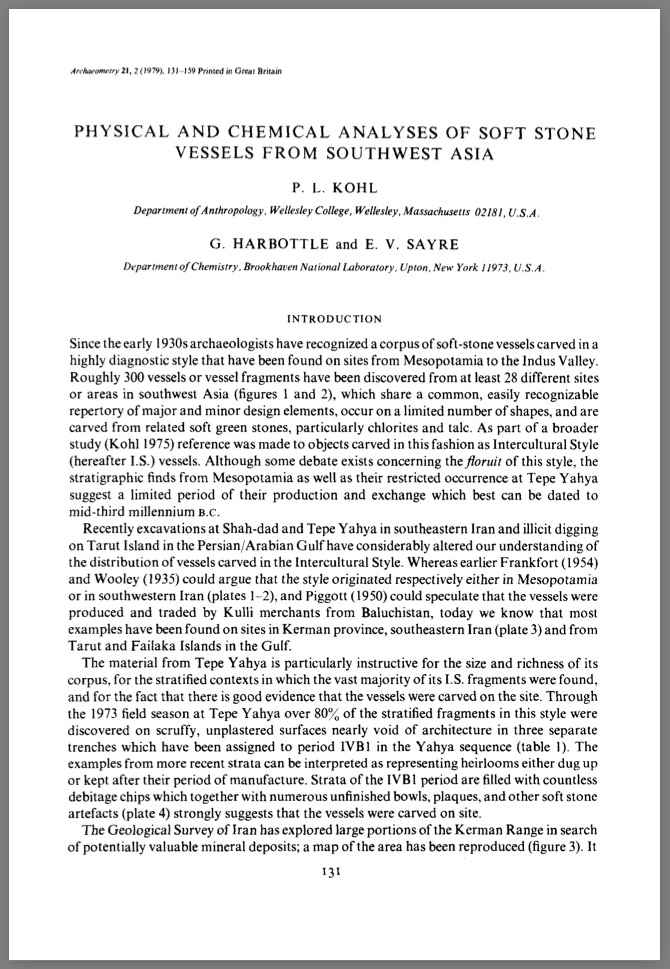
Physical and chemical analyses of soft stone vessels from Southwest Asia
Journal Article
Kohl, P.L., Harbottle, G. and Sayre, E.V. (1979) Physical and chemical analyses of soft stone vessels from Southwest Asia. Archaeometry, Vol. 21, No. 2, pp. 131–159.
gems, archaeology, archaeogemology, India, Indus River Civilization, Harappa, Pakistan, Iran
Since the early 1930s, archaeologists have identified a corpus of soft-stone vessels carved in a highly diagnostic style, found at sites ranging from Mesopotamia to the Indus Valley. Approximately 300 vessels or fragments have been recovered from at least 28 locations across Southwest Asia (figures 1 and 2), all sharing a common and easily recognizable repertoire of design elements, limited shape types, and a consistent use of related soft green stones, particularly chlorite and talc. In a broader study (Kohl 1975), these objects were termed Intercultural Style (IS) vessels. Although the origins of the style remain debated, stratigraphic evidence from Mesopotamia and the concentrated presence at Tepe Yahya suggest a relatively brief period of production and circulation, best dated to the mid-third millennium B.C. More recent excavations at Shahdad and Tepe Yahya in southeastern Iran, along with illicit digs on Tarut Island in the Persian/Arabian Gulf, have significantly reshaped our understanding of their distribution. While earlier scholars such as Frankfort (1954), Woolley (1935), and Piggott (1950) proposed origins in Mesopotamia, southwestern Iran, or Baluchistan, current evidence shows that the majority of finds come from Kerman province in southeastern Iran (plate 3), as well as from Tarut and Failaka Islands in the Gulf.