
Four Treasures Reference Database
Record No. 26875
Madagascar and Africa: I. The Problem of the Bara
Journal Article
Kent, R.K. (1968) Madagascar and Africa: I. The Problem of the Bara. Journal of African History, Vol. 9, No. 3, pp. 387–408.
Sinkankas/Born No.: NIS/NIB | RWHL
gems, Africa, Madagascar
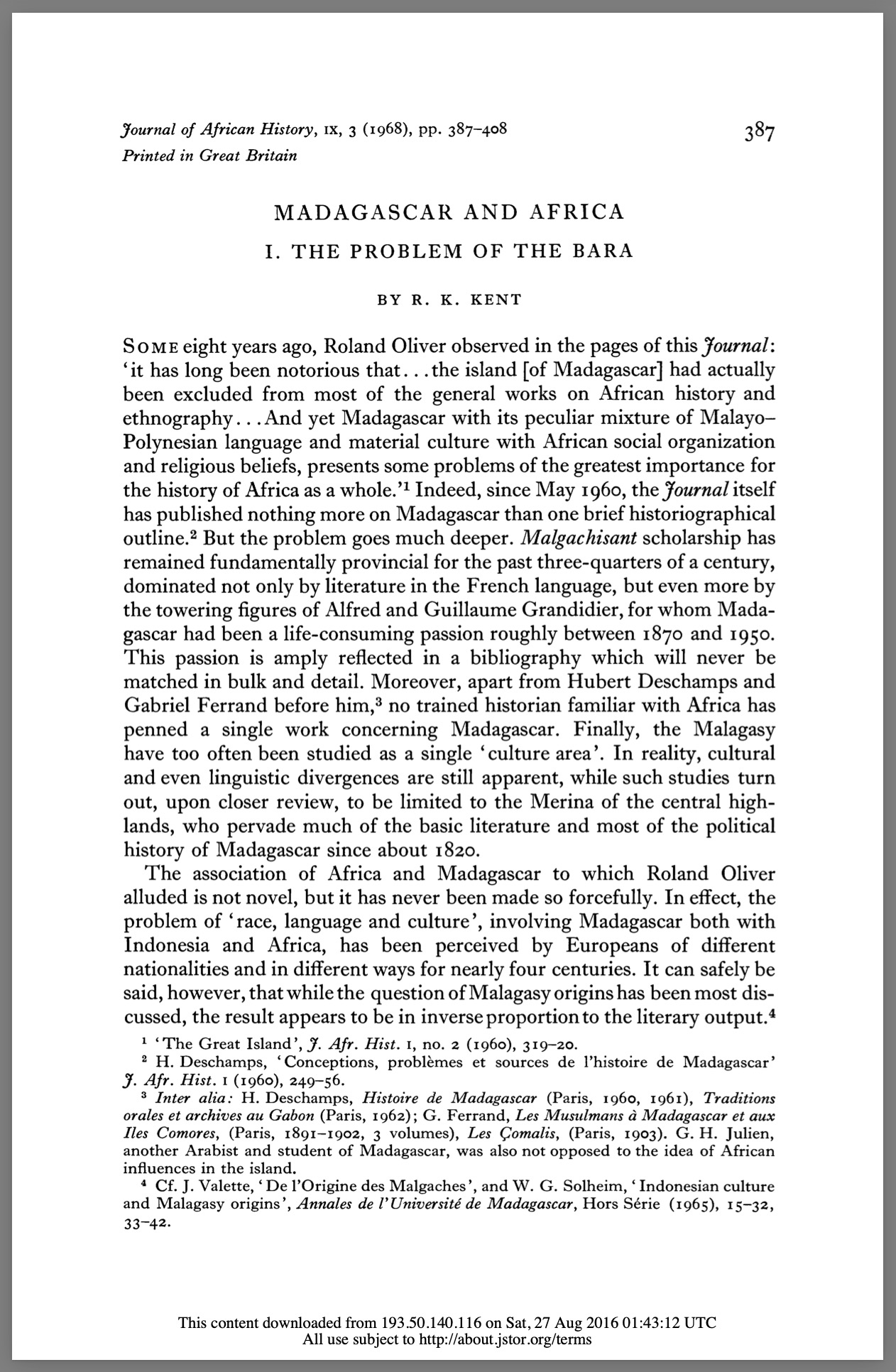
Some eight years ago, Roland Oliver noted that Madagascar had long been excluded from most general works on African ethnography, despite its unique combination of a Polynesian language and material culture with African social and religious beliefs—features that present important questions for the broader history of Africa. Since May 1963, only a single outline on Madagascar has appeared in the journal, reflecting a deeper issue: Malagasy studies have remained fundamentally provincial for the past three decades, dominated by French-language literature and the towering scholarly legacy of Alfred and Guillaume Grandidier, for whom Madagascar was a lifelong passion. This dedication is reflected in a vast and detailed bibliography, unmatched in the field. Yet, apart from Gabriel Ferrand before them, no professionally trained historian had written a significant work on Madagascar. The island has too often been treated as a single cultural area, although significant ethnic and linguistic differences remain—many of which, on closer examination, seem confined to the Merina highlands population, who dominate much of the literature and historical narrative from around 1820 onward. The association between Africa and Madagascar has long been recognized, but never fully developed in academic discourse. The complex problem of “race, language, and culture,” involving both Indonesian and African elements, has been approached by Europeans of various nationalities for nearly four centuries. Yet, while much has been written on the origins of the Malagasy people, the clarity of conclusions seems inversely proportional to the volume of the literature.