
Four Treasures Reference Database
Record No. 26884
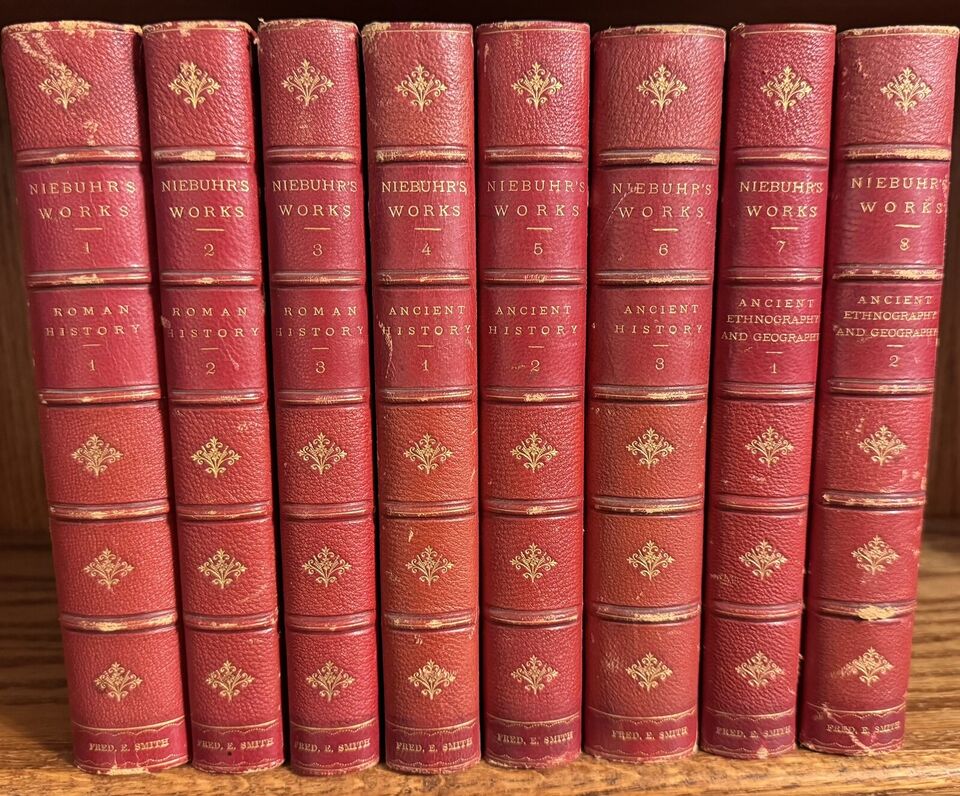
The Collected Lectures of B. G. Niebuhr on Roman History; Ancient History, Including the History of Greece; Ancient Ethnography and Geography
Book
Schmitz, L. (1852–1853) The Collected Lectures of B. G. Niebuhr on Roman History; Ancient History, Including the History of Greece; Ancient Ethnography and Geography. London, Walton And Maberly, 8 Vols., Volume 2: Roman History , 375 pp.
Sinkankas/Born No.: NIS/NIB | RWHL
gems, ancient history, Roman history, Greek history
Niebuhr, a Danish-German statesman and historian, was Germany’s preeminent authority on ancient Rome and a foundational figure in modern historiography. While Classical Rome—more than Greece—captivated German thinkers, it was Niebuhr’s lectures at the University of Berlin from 1810 onward that inspired German patriotism through his rigorous analysis of Roman economics and government. Seen as both a leader of Romantic nationalism and a scholar shaped by Enlightenment rationalism, Niebuhr combined philological rigor with a nuanced grasp of both particular and general historical phenomena. Born in Copenhagen, the son of famed geographer Carsten Niebuhr, he received a rich early education and by 1794 was already a gifted classical scholar fluent in multiple languages. He entered the University of Kiel to study law and philosophy, and later served briefly as private secretary to Denmark’s finance minister, Count Schimmelmann. In 1798, he resigned and traveled to Great Britain, studying agriculture and physics for a year in Edinburgh. He later remarked, “My early residence in England gave me one important key to Roman history,” emphasizing how personal observation of civil life enriched his understanding of antiquity. Niebuhr’s Roman History is widely regarded as epoch-making, not only for reshaping Roman studies but also for influencing broader historical method. As Leonhard Schmitz noted, Niebuhr’s insights—on Rome’s population, the origins of the plebs, patrician-plebeian relations, the ager publicus, and more—set new standards for historical inquiry. While some of his reconstructions, such as deriving early Roman history from ancient ballads, proved less enduring, his pioneering use of inference over unreliable tradition, his emphasis on ethnological distinctions, and his recognition of myth as a critical historical tool laid the groundwork for modern historical criticism. Most significantly, by shifting attention from legendary lawgivers to institutions, customs, and social structures, he helped shape the modern conception of history as the study of enduring societal patterns.