
Four Treasures Reference Database
Record No. 26909
Rock crystal: The key to cut glass and diatreta in Persia and Rome
Journal Article
Vickers, M. (1996) Rock crystal: The key to cut glass and diatreta in Persia and Rome. Journal of Roman Archaeology, Vol. 9, pp. 48–65.
gems, quartz, rock crystal, Persia, Rome, lapidary arts
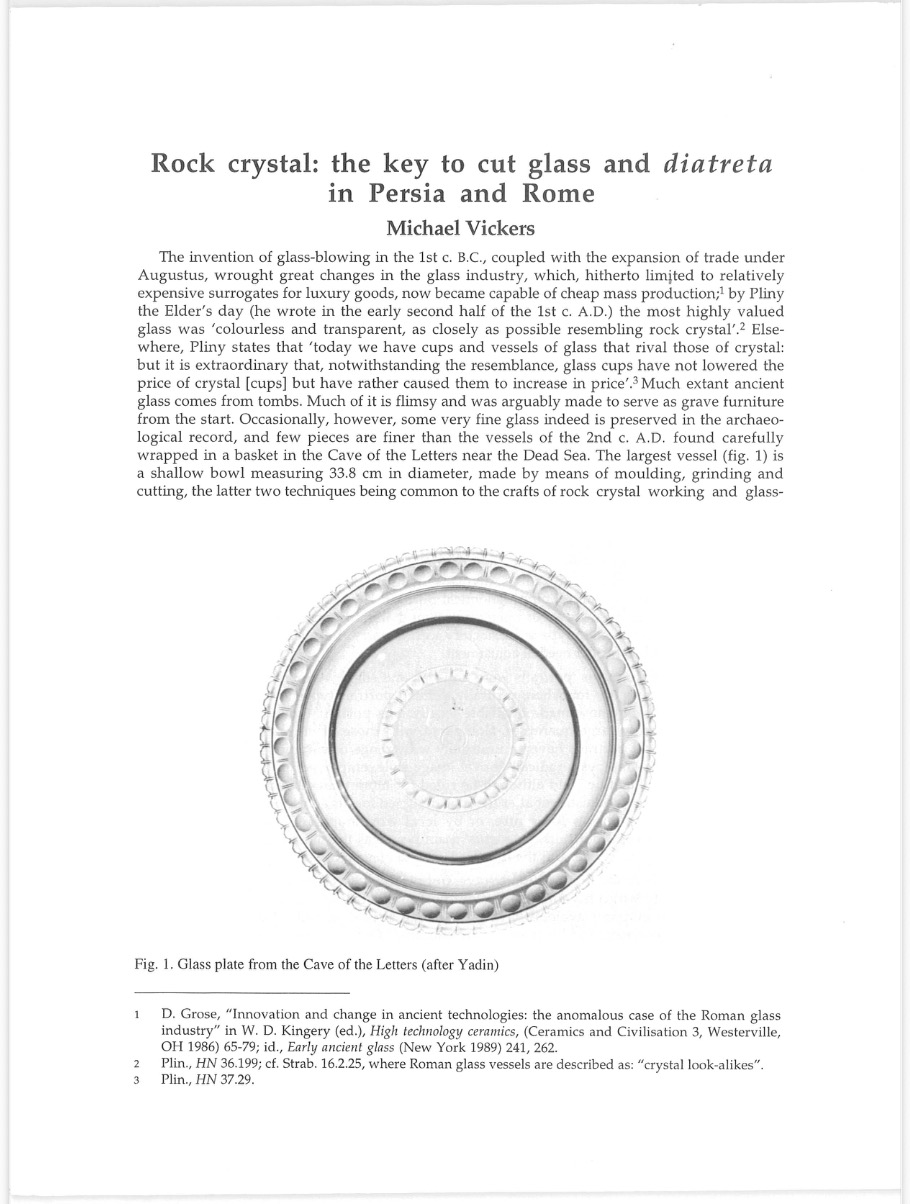
The invention of glass-blowing in the 1st century B.C., coupled with the expansion of trade under Augustus, wrought great changes in the glass industry, which, hitherto limited to relatively expensive surrogates for luxury goods, now became capable of cheap mass production; by Pliny the Elder’s day (he wrote in the early second half of the 1st century A.D.) the most highly valued glass was “colourless and transparent, as closely as possible resembling rock crystal.” Elsewhere, Pliny states that “today we have cups and vessels of glass that rival those of crystal: but it is extraordinary that, notwithstanding the resemblance, glass cups have not lowered the price of crystal [cups] but have rather caused them to increase in price.” Much extant ancient glass comes from tombs. Much of it is flimsy and was arguably made to serve as grave furniture from the start. Occasionally, however, some very fine glass indeed is preserved in the archaeological record, and few pieces are finer than the vessels of the 2nd century A.D. found carefully wrapped in a basket in the Cave of the Letters near the Dead Sea. The largest vessel is a shallow bowl measuring 33.8 cm in diameter, made by means of moulding, grinding and cutting, the latter two techniques being common to the crafts of rock crystal working and glass-making. The circular facets which occur around the rim and tondo decoration are cut on the back of the dish, but shine through from behind. This article takes as its point of departure an important paper by Axel von Saldern in which he states his belief that “practically all the glass made up to the time when glass-blowing became generally accepted followed in form and decoration vessels made in other materials,” including “semi-precious stones,” and “gold and silver.” The reason it has been written at all is that the opposite view, that workers in precious materials might have copied glass, still persists.