
Four Treasures Reference Database
Record No. 26931
Some experiments and observations on the colours used in painting by the Ancients
Journal Article
Davy, H. (1815) Some experiments and observations on the colours used in painting by the Ancients. Philosophical Transactions of the Royal Society of London, Vol. 105, pp. 97–124.
Sinkankas/Born No.: NIS/NIB | RWHL
gems, color science, Egyptian blue
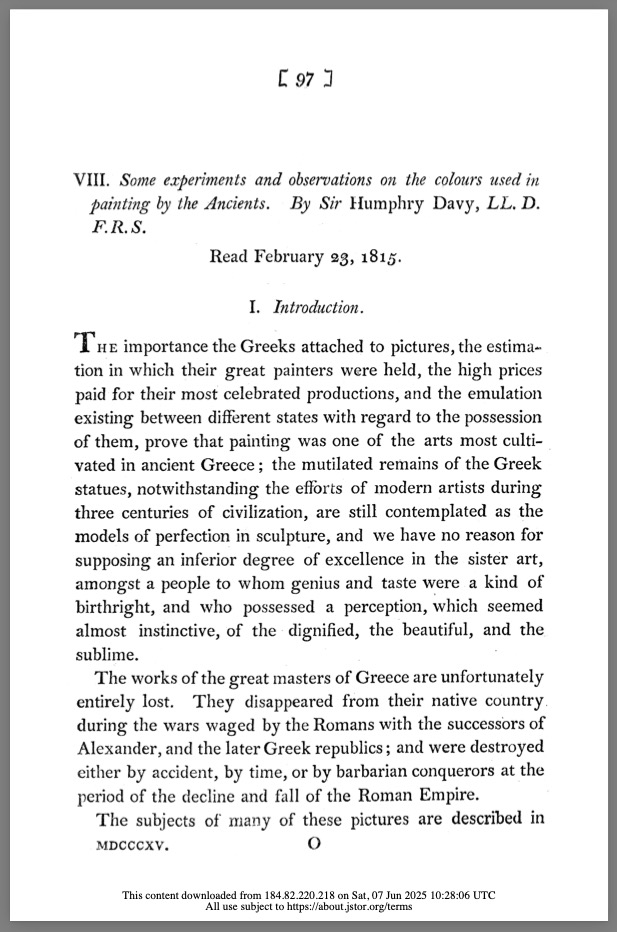
The importance the Greeks attached to pictures, the high esteem in which their great painters were held, the immense prices paid for their masterpieces, and the rivalry among city-states to possess them all attest to the prominence of painting as one of the most cultivated arts in ancient Greece. While the mutilated remains of Greek sculpture still stand as unsurpassed models of perfection despite centuries of modern effort, there is no reason to assume a lesser degree of excellence in painting, especially among a people whose innate genius and taste endowed them with an almost instinctive perception of the dignified, beautiful, and sublime. Sadly, the original works of the great Greek masters have been entirely lost, vanishing from their homeland during the Roman conquests of the Hellenistic world and subsequently destroyed by time, accident, or barbarian invaders during the fall of the Roman Empire. However, descriptions of these paintings in ancient literature, along with the vase designs—often misattributed as Etruscan but actually by artists of Magna Graecia and likely copies of famous works—and the frescoes uncovered in Rome, Herculaneum, and Pompeii, offer us a faint glimpse into their subjects, style, execution, and colouring.