
Four Treasures Reference Database
Record No. 26940
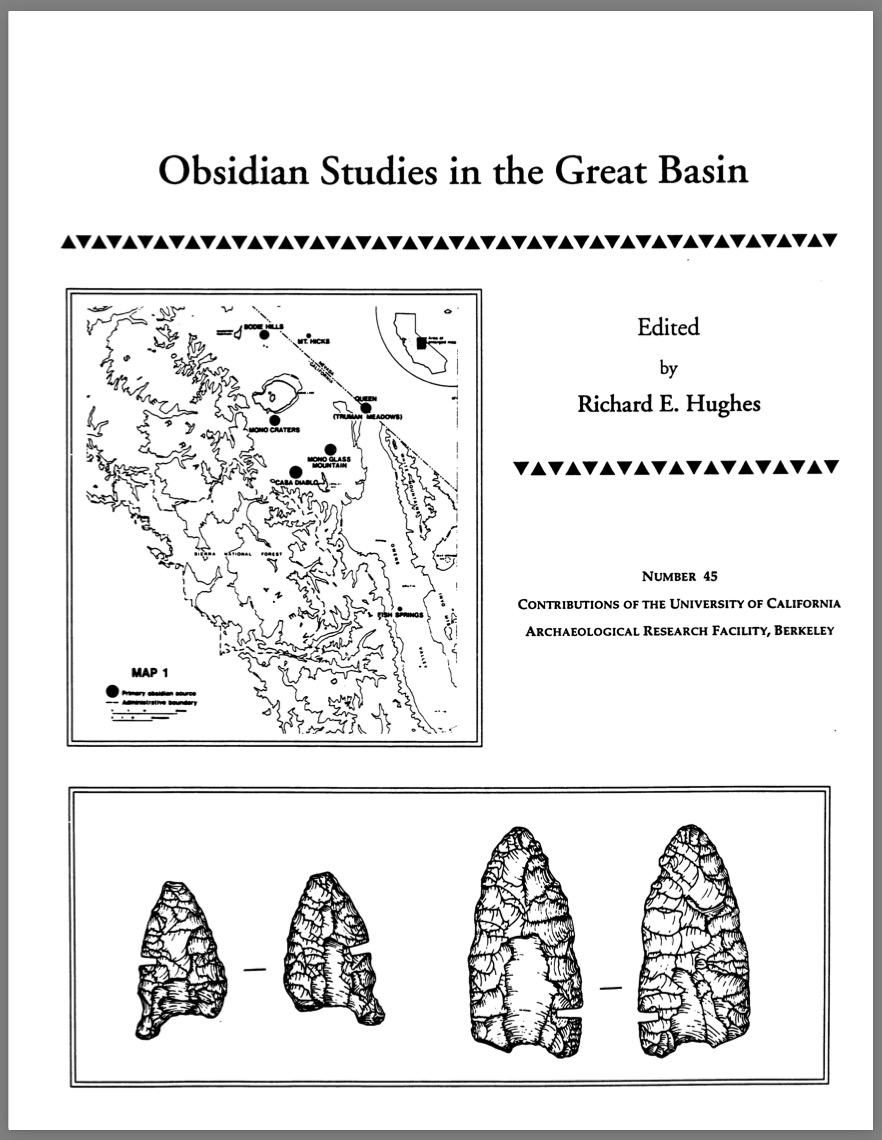
X-ray fluorescence analysis of some western North American obsidians
Book Section
Nelson, F.W. (1984) X-ray fluorescence analysis of some western North American obsidians. In: Obsidian Studies in the Great Basin, Contributions of the University of California Archaeological Research Facility 45, pp. 27–62.
Sinkankas/Born No.: NIS/NIB | RWHL
gems, obsidian, North America, natural glass
The elemental composition of several geologic sources of obsidian in Arizona, California, southern Idaho, Nevada, northern New Mexico, Oregon, western Utah, and northwestern Wyoming has been determined using X-ray fluorescence spectrometry (Figure 1). The results of analyses of several obsidian artifacts from archaeological sites in this area also are reported and compared to the analyses of the obsidian sources. Some of the sources reported in a previous study (Nelson and Holmes 1979) have been reanalyzed; several new sources have been analyzed, and two new trace elements (yttrium and niobium) have been added to the analyses. In addition to reporting the trace element composition of the obsidian sources and artifacts, the methods used to conduct the analyses also will be described. The statistical procedures used to distinguish between the geologic sources of obsidian and to correlate the archaeological obsidian artifacts to the geologic sources also will be explained. After the results of analysis of the obsidian geologic sources and artifacts have been presented, the artifacts will be assigned to their probable geological obsidian source by statistical and graphical means. Obsidian is useful for this type of study because: 1) most of the geologic sources are homogeneous; that is, the elemental composition usually does not vary significantly from one area of the source to another (see Bowman, Asaro, and Perlman 1971, 1973a, 1973b; Zeitlin 1979 for possible exceptions); 2) there are a limited number of sources; 3) each source appears to have its own unique trace element composition; and 4) the properties of obsidian are not changed during the manufacture of the artifacts. In addition to source analysis, it has been demonstrated that it is possible to study the economics of obsidian use and exchange rather thoroughly from extraction to final discard (Clark 1981; Clark and Lee 1981). Clark (1981) suggests that source analysis of obsidian should only be a small part of the study of obsidian artifacts and that source analysis, replication studies, functional analysis, and careful excavation are all basic to understanding obsidian use and exchange among prehistoric peoples. However, in this paper only the analysis of obsidian for its trace element composition is described.