
Four Treasures Reference Database
Record No. 26949
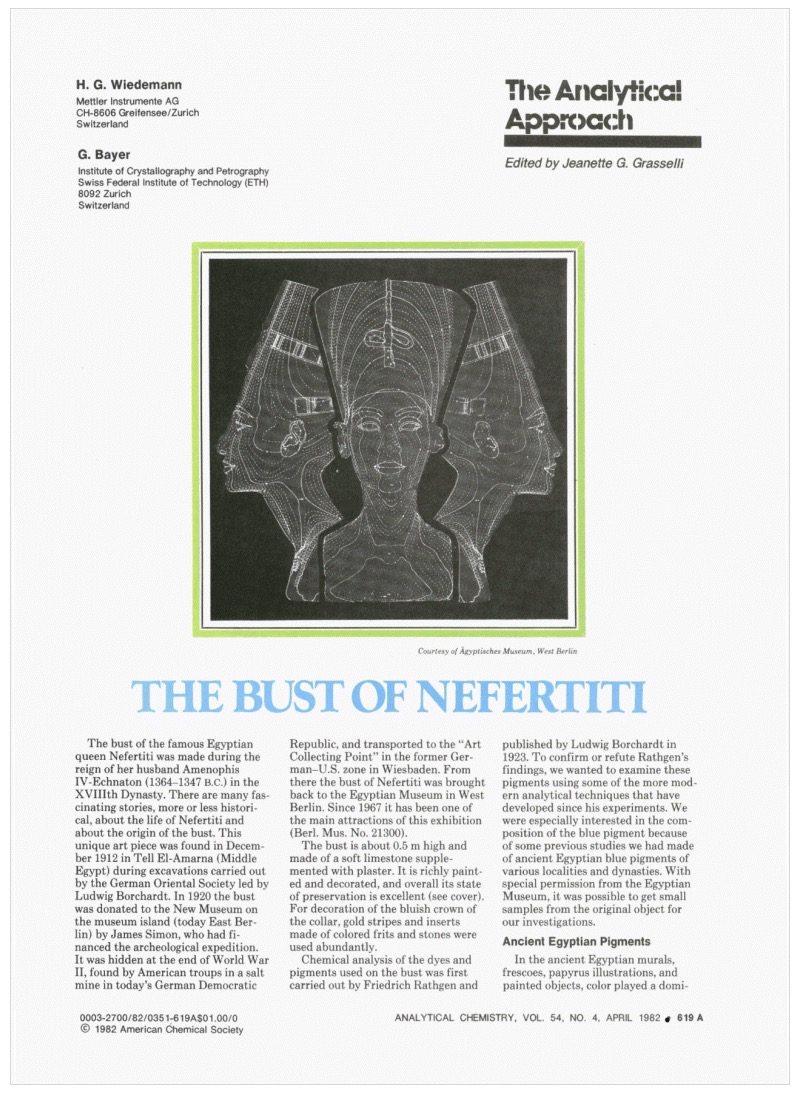
The bust of Nefertiti
Journal Article
Wiedemann, H.G. and Bayer, G. (1982) The bust of Nefertiti. Analytical Chemistry, Vol. 54, No. 4, April, pp. 619–628A.
gems, archaeology, archaeogemology, Africa, Egypt, color science, Egyptian blue
The bust of the famous Egyptian queen Nefertiti was made during the reign of her husband Amenophis IV–Echnaton (1364–1347 B.C.) in the XVIIIth Dynasty. There are many fascinating stories, more or less historical, about the life of Nefertiti and about the origin of the bust. This unique art piece was found in December 1912 in Tell El-Amarna (Middle Egypt) during excavations carried out by the German Oriental Society led by Ludwig Borchardt. In 1920 the bust was donated to the New Museum on the museum island (today East Berlin) by James Simon, who had financed the archaeological expedition. It was hidden at the end of World War II, found by American troops in a salt mine in what is now the German Democratic Republic, and transported to the “Art Collecting Point” in the former German-U.S. zone in Wiesbaden. From there the bust of Nefertiti was brought back to the Egyptian Museum in West Berlin. Since 1967 it has been one of the main attractions of this exhibition (Berl. Mus. No. 21300). The bust is about 0.5 m high and made of a soft limestone supplemented with plaster. It is richly painted and decorated, and overall its state of preservation is excellent (see cover). For decoration of the bluish crown and the collar, gold stripes and inserts made of colored frits and stones were used abundantly. Chemical analysis of the dyes and pigments used on the bust was first carried out by Friedrich Rathgen and published by Ludwig Borchardt in 1923. To confirm or refute Rathgen’s findings, we wanted to examine these pigments using some of the more modern analytical techniques that have developed since his experiments. We were especially interested in the composition of the blue pigment because of some previous studies we had made of ancient Egyptian blue pigments of various localities and dynasties. With special permission from the Egyptian Museum, it was possible to get small samples from the original object for our investigations.