
Four Treasures Reference Database
Record No. 26952
Application to gem identification of fluorescence X-ray analysis
Journal Article
Ohguchi, H. (1981) Application to gem identification of fluorescence X-ray analysis. Journal of the Gemological Society of Japan, Vol. 8, No. 1–4, pp. 145–149.
Close Abstract
Hide Keywords
Copy Reference
gems, advanced testing, XRF
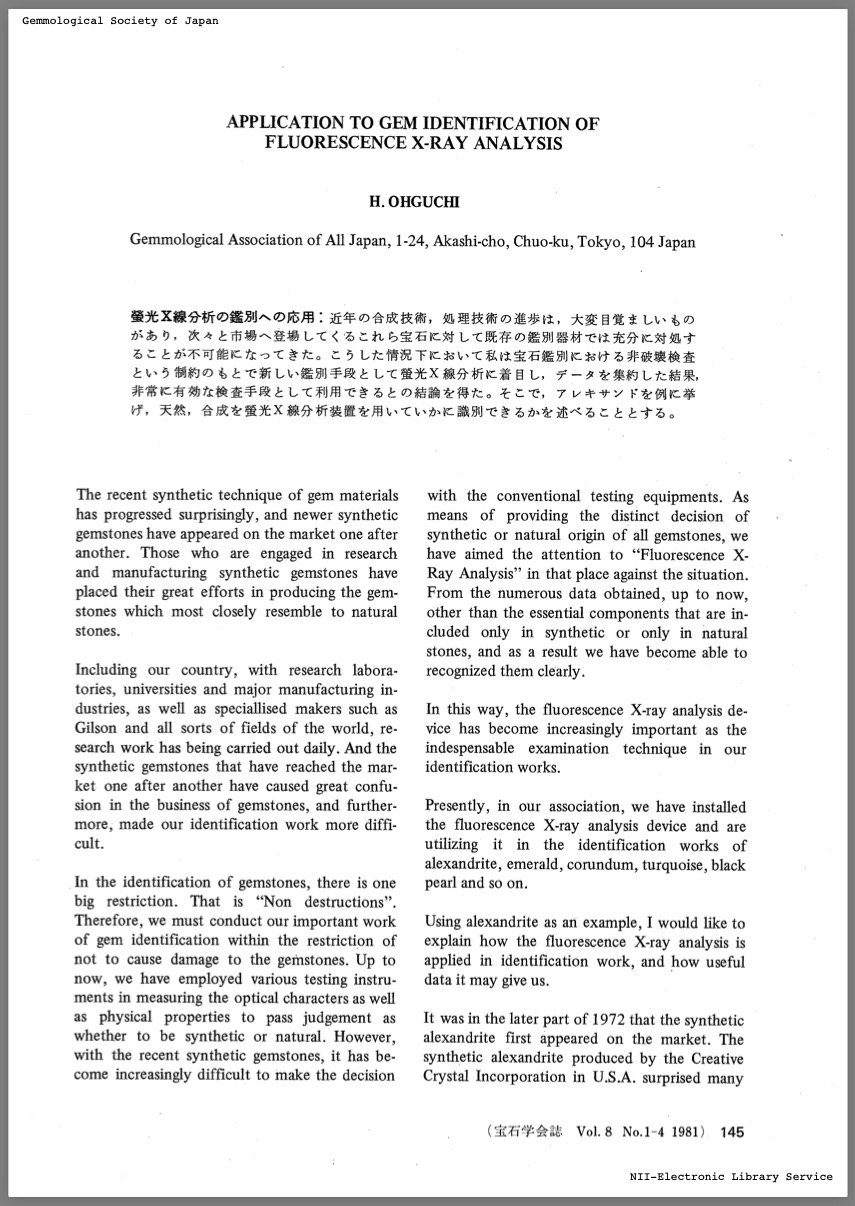
The recent synthetic technique of gem materials has progressed surprisingly, and newer synthetic gemstones have appeared on the market one after another. Those who are engaged in research and manufacturing synthetic gemstones have placed their great efforts in producing the gemstones which most closely resemble natural stones. Including our country, with research laboratories, universities, and major manufacturing industries, as well as specialized makers such as Gilson and all sorts of fields of the world, research work has been carried out daily. And the synthetic gemstones that have reached the market one after another have caused great confusion in the business of gemstones, and furthermore, made our identification work more difficult. In the identification of gemstones, there is one big restriction. That is “Non-destructiveness.” Therefore, we must conduct our important work of gem identification within the restriction of not causing damage to the gemstones. Up to now, we have employed various testing instruments in measuring the optical characters as well as physical properties to pass judgment as to whether a gemstone is synthetic or natural. However, with the recent synthetic gemstones, it has become increasingly difficult to make the decision with the conventional testing equipment. As means of providing the distinct decision of synthetic or natural origin of all gemstones, we have turned our attention to “Fluorescence X-Ray Analysis” in that place against the situation. From the numerous data obtained up to now, other than the essential components that are included only in synthetic or only in natural stones, and as a result, we have become able to recognize them clearly. In this way, the fluorescence X-ray analysis device has become increasingly important as the indispensable examination technique in our identification work. Presently, in our association, we have installed the fluorescence X-ray analysis device and are utilizing it in the identification work of alexandrite, emerald, corundum, turquoise, black pearl, and so on.