
Four Treasures Reference Database
Record No. 26960
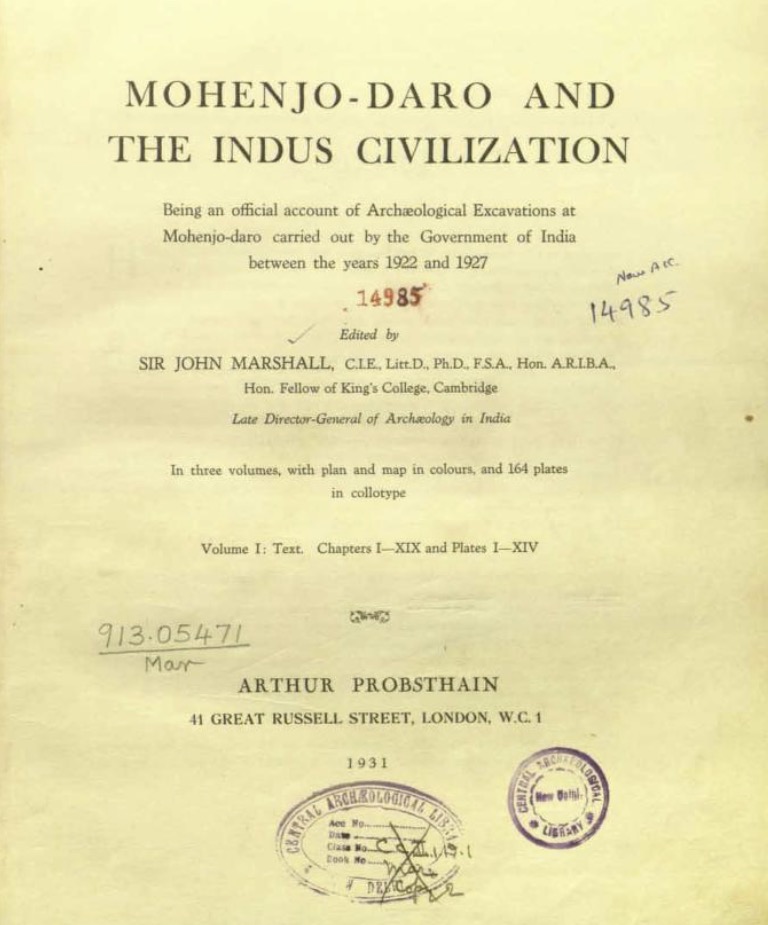
Mohenjo-daro and the Indus Civilization: Being an official account of archæological excavations at Mohenjo-daro carried out by the government of India between the years 1922 and 1927
Book
Marshall, J. (1931) Mohenjo-daro and the Indus Civilization: Being an official account of archæological excavations at Mohenjo-daro carried out by the government of India between the years 1922 and 1927. London, A. Probsthain, 3 Vols., 364 pp.
Sinkankas/Born No.: 4227; NIB | RWHL
gems, ancient gemology, ancient jewelry, early metallurgy, India, Indus, green stones, green grossular, hydrogrossular, jade
Hitherto it has commonly been supposed that the pre-Aryan peoples of India were on an altogether lower plane of civilization than their Aryan conquerors; that to the latter they were much what the Helots were to the Spartans, or the Slavs to their Byzantine overlords—a race so servile and degraded, that they were commonly known as Dasas or slaves. The picture of them gleaned from the Hymns of the Rigveda was that of black skinned, flat-nosed barbarians, as different from the fair Aryans in physical aspect as they were in speech and religion, though at the same time it was evident that they must have been rich in cattle, good fighters, and possessed of many forts in which they defended themselves against the invaders. These “forts”, however, were explained by Vedic scholars as being no more than occasional places of refuge—simple earthworks, that is to say, surrounded, may be, by palisades or rough stone walls; for, seeing that the Aryans themselves were still in the village State and that their society was in other respects correspondingly primitive, it was deemed impossible that the older races of India—the contemptible, outcast Dasas—could already have been living in well-built cities or fortresses, or in other respects have attained to a higher state of culture. Mentally, physically, socially, and religiously, their inferiority to their conquerors was taken for granted, and little or no credit was given them for the achievements of Indian civilization. Never for a moment was it imagined that five thousand years ago, before ever the Aryans were heard of, the Panjab and Sind, if not other parts of India as well, were enjoying an advanced and singularly uniform civilization of their own, closely akin but in some respects even superior to that of contemporary Mesopotamia and Egypt. Yet this is what the discoveries at Harappa and Mohenjo-daro have now placed beyond question. They exhibit the Indus peoples of the fourth and third millennia B.C., in possession of a highly developed culture in which no vestige of Indo-Aryan influence is to be found. Like the rest of Western Asia, the Indus country is still in the Chalcolithic Age—that age in which arms and utensils of stone continue to be used side by side with those of copper or bronze. Their society is organized in cities; their wealth derived mainly from agriculture and trade, which appears to have extended far and wide in all directions. They cultivate wheat and barley as well as the date palm. They have domesticated the humped zebu, buffalo, and short-horned bull, besides the sheep, pig, dog, elephant, and camel; but the cat and probably the horse are unknown to them. For transport they have wheeled vehicles, to which oxen doubtless were yoked. They are skilful metal workers, with a plentiful supply of gold, silver, and copper. Lead, too, and tin are in use, but the latter only as an alloy in the making of bronze. With spinning and weaving they are thoroughly conversant. Their weapons of war and of the chase are the bow and arrow, spear, axe, dagger, and mace. The sword they have not yet evolved; nor is there any evidence of defensive body armour. Among their other implements, hatchets, sickles, saws, chisels, and razors are made of both copper and bronze; knives and celts sometimes of these metals, sometimes of chert or other hard stones. For the crushing of grain they have the muller and saddle-quern but not the circular grindstone. Their domestic vessels are commonly of earthenware turned on the wheel and not infrequently painted with encaustic designs; more rarely they are of copper, bronze, or silver. The ornaments of the rich are made of the precious metals or of copper, sometimes overlaid with gold, of faience, ivory, carnelian, and other stones; for the poor, they are usually of shell or terra-cotta. Figurines and toys, for which there is a wide vogue, are of terra-cotta, and shell and faience are freely used, as they are in Sumer and the West generally, not only for personal ornaments but for inlay work and other purposes. With the invention of writing the Indus peoples are also familiar, and employ for this purpose a form of script which, though peculiar to India, is evidently analogous to other contemporary scripts of Western Asia and the Nearer East. Sinkankas: An account of the archaeological remains at Mohenjo-Daro in the Indus Valley unearthed by the Government of India between 1922 and 1927. Age fixed between 3250–2750 B.C. Chalcedony in all its forms prominent among the objects and frequently display an advanced degree of lapidary skill. Other gemstone objects are made from rock crystal, amethyst, jadeite, turquoise, lapis, amazonite, steatite, alabaster, and also non-gem materials. “Not seen; my reference to source lost.”