
Four Treasures Reference Database
Record No. 26961
Two Hellenistic gems rediscovered
Journal Article
Spier, J. (1991) Two Hellenistic gems rediscovered. Antike Kunst, Vol. 34, No. 2, pp. 91–96, plate 10.
Sinkankas/Born No.: NIS/NIB | RWHL
gems, glyptic, engraved gems, agate, cameo, intaglio, collection, comparanda, catalog
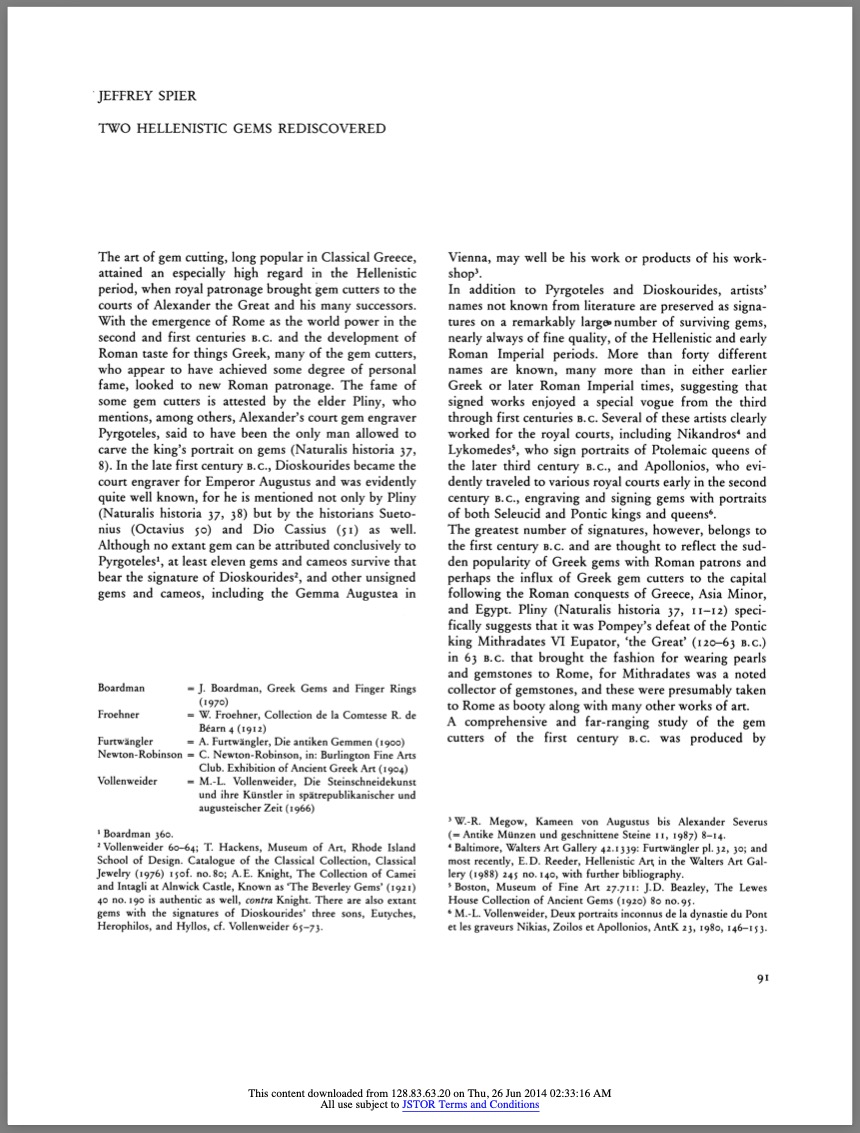
The art of gem cutting, long popular in Classical Greece, attained an especially high regard in the Hellenistic period, when royal patronage brought gem cutters to the courts of Alexander the Great and his many successors. With the emergence of Rome as the world power in the second and first centuries B.C. and the development of Roman taste for things Greek, many of the gem cutters, who appear to have achieved some degree of personal fame, looked to new Roman patronage. The fame of some gem cutters is attested by the elder Pliny, who mentions, among others, Alexander’s court gem engraver Pyrgoteles, said to have been the only man allowed to carve the king’s portrait on gems (Naturalis historia 37, 8). In the late first century B.C., Dioskourides became the court engraver for Emperor Augustus and was evidently quite well known, for he is mentioned not only by Pliny (Naturalis historia 37, 38) but by the historians Suetonius (Octavius 50) and Dio Cassius (51) as well. Although no extant gem can be attributed conclusively to Pyrgoteles, at least eleven gems and cameos survive that bear the signature of Dioskourides, and other unsigned gems and cameos, including the Gemma Augustea in Vienna, may well be his work or products of his workshop.