
Four Treasures Reference Database
Record No. 26963
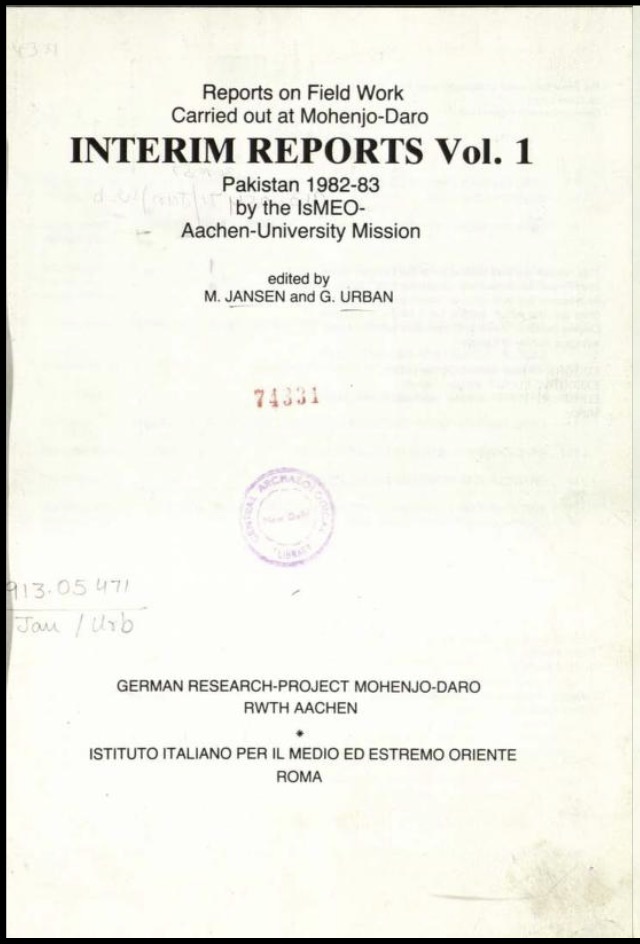
Reports on Field Work Carried out at Mohenjo-Daro: Interim Reports, Pakistan 1982–83, Vol. 1 and 1983–84 Vol. 2
Edited Book
Jansen, M. and Urban, G., editor (1987) Reports on Field Work Carried out at Mohenjo-Daro: Interim Reports, Pakistan 1982–83, Vol. 1 and 1983–84 Vol. 2.. Aachen, German Research-Project Mohenho-Daro, 205 pp..
Sinkankas/Born No.: NIS/NIB | RWHL
gems, archaeology, archaeogemology, Africa, Egypt
The IsMEO participation in the Moenjodaro Project, jointly with the RWTH, is aimed at expanding some aspects of the scientific project initiated at the end of the sixties with the excavations of Shahr-i Sokhta, the main protohistorical center in Iranian Sistan. Both initiatives are motivated by the same determination to enlarge the study of early Indo-Iranian civilizations of the third millennium BC, incorporating the Middle Asian Bronze Age urban cultures recently brought to light. The discovery of these pristine stone formations across the oases belts of eastern Iran, southern Turkmenia and Afghanistan has opened up a much deeper historical perspective, defining the cultural complexity that the emergence of the greater religious and political movements underwent in this part of Asia. Such expansion into the prehistoric period can only be based on the integration of a broad spectrum of disciplines in long-term research programmes. The experience gathered at Shahr-i Sokhta has highlighted how fruitful such a multidirectional approach can be to a critical understanding of early urbanism and its cultural implications. This type of strategy has become quite a standard procedure of IsMEO in its tackling of the ever-complex problems involved in the study of Asian civilizations. More institutionalized forms of international cooperation are corollary to such a policy of long-term investments. The agreement IsMEO and RWTH signed in Rome on December 14th 1983 to cooperate on the exploration of Moenjodaro represents the first milestone in such a direction.