
Four Treasures Reference Database
Record No. 26966
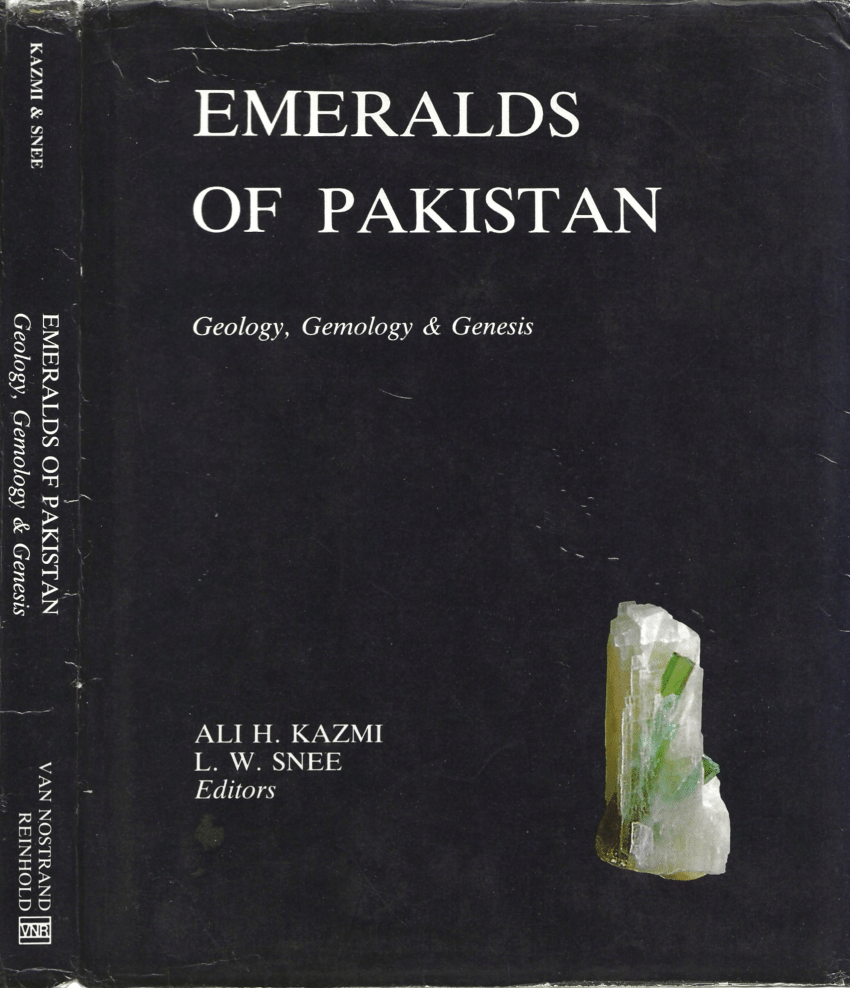
Regional chemical differences among emeralds and host rocks of Pakistan and Afghanistan
Book Section
Snee, L.W., Foord, E.E., Hill, B. and Carter, S.J. (1989) Regional chemical differences among emeralds and host rocks of Pakistan and Afghanistan. In: Emeralds of Pakistan: Geology, Gemology and Genesis, New York: Geological Survey of Pakistan and Van Nostrand Reinhold, pp. 93–123.
ISBN/ISSN: 9781490000000 | Sinkankas/Born No.: NIS/NIB | RWHL*
beryl, emerald, Pakistan, gems, pegmatitic emerald
Emerald is the exquisite result of the chemical substitution of a small amount of chromium (or vanadium) for aluminum in Be₃Al₂Si₆O₁₈, the mineral beryl (Deer and others, 1986). On the world gem market, if the green coloration of emerald is caused by any element other than chromium, it is not called emerald according to standards adopted by the London Chamber of Commerce and Industry’s Precious Stone Trade Section (Farm, 1975). The coexistence in nature of chromium and beryllium is unusual and thus emerald is one of the rarest and most precious gemstones. The general incompatibility of beryllium and chromium is the result of their different geochemical behavior as clearly demonstrated in the compilation of chemical data for igneous rocks by Wedepohl (1978). Beryl, the most common beryllium mineral, forms during late-stage (pneumatolytic and hydrothermal) igneous activity. Because Be²⁺ has a small ionic radius (approximately 0.3 Å; Shannon and Prewitt, 1969), it is excluded from the crystal structure of most minerals. In addition, because of the small average continental crustal abundance of beryllium (less than 5 ppm; Wedepohl, 1978), beryllium is not concentrated enough to form beryl until late stages of igneous activity, i.e., during the formation of pegmatites or hydrothermal deposits. In contrast, chromium, also a trace constituent in the Earth’s crust (averaging approximately 50 ppm; Wedepohl, 1978), precipitates early during igneous fractionation in the mineral chromite, FeCr₂O₄, or it substitutes for aluminum, iron, magnesium, or titanium in early igneous phases, such as pyroxene, amphibole, spinel, or garnet. Thus, the greatest abundance of chromium is found in ultramafic and mafic rocks. So even though chromium, which has an ionic radius of 0.62 Å (Cr³⁺; Shannon and Prewitt, 1969), will readily substitute for aluminum, which has an ionic radius of 0.54 Å (Al³⁺; Shannon and Prewitt, 1969), in the beryl crystal structure, chromium is not expected in the late-stage liquid or vapor from which beryl may be formed. Special circumstances are necessary to bring chromium and beryllium together; as a result, emerald is extremely rare and is found only where geologic processes have been favorable for its formation. One of the places on the Earth where the geologic environment is appropriate for emerald occurrence is the area of northern Pakistan and Afghanistan. In this region, oceanic and island arc rocks that are rich in chromium are juxtaposed against felsic, beryllium-bearing continental rocks of the Indian plate. Within this geologic setting, emeralds are found in two very different geologic environments. In the economically most important deposits, emeralds formed from hydrothermal fluids that penetrated along shear zones into talc-carbonate schists within mélange zones. In the other setting, the emeralds are in pegmatites or quartz-ankerite veins which intruded schist, gneiss, and amphibolite. In both cases, the beryl apparently precipitated from a late-stage beryllium-carrying hydrothermal or pneumatolytic fluid which had scavenged chromium from the host rock.