
Four Treasures Reference Database
Record No. 26968
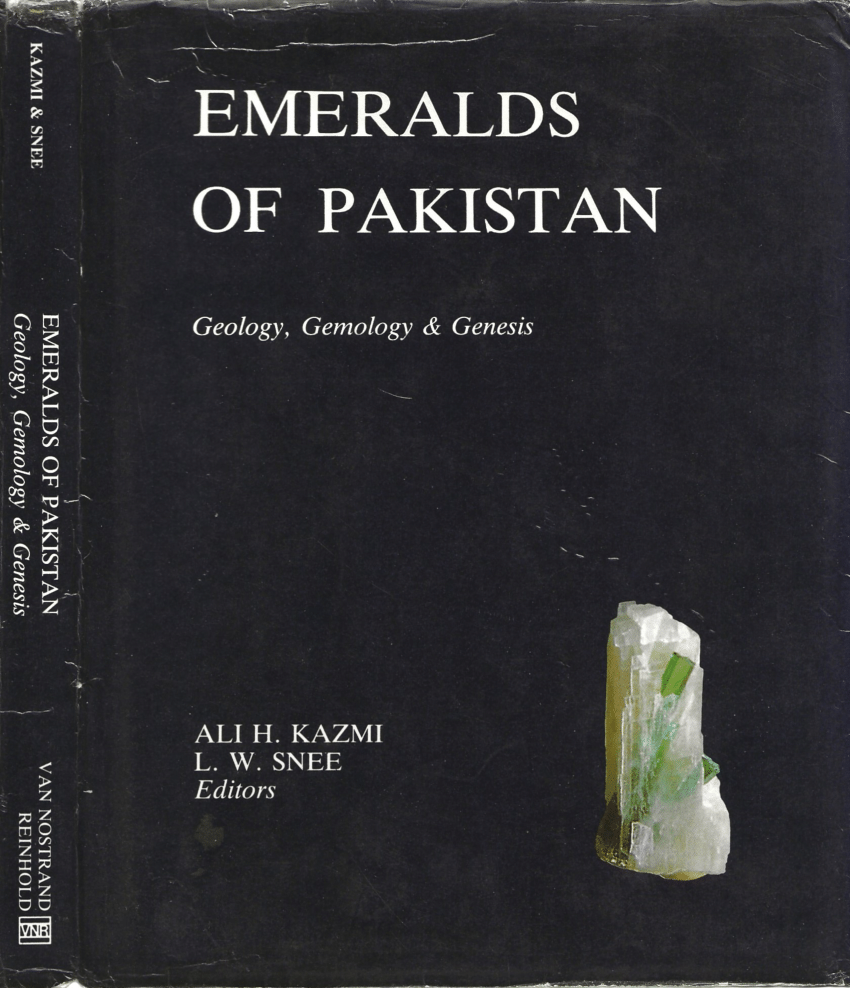
Origin and classification of Pakistani and world emerald deposits
Book Section
Snee, L.W. and Kazmi, A.H. (1989) Origin and classification of Pakistani and world emerald deposits. In: Emeralds of Pakistan: Geology, Gemology and Genesis, New York: Geological Survey of Pakistan and Van Nostrand Reinhold, pp. 229–236.
ISBN/ISSN: 9781490000000 | Sinkankas/Born No.: NIS/NIB | RWHL*
Close Abstract
Hide Keywords
Copy Reference
beryl, emerald, Pakistan, gems, pegmatitic emerald, emerald geology
Emerald, formed by the substitution of a small amount of chromium for aluminum in the beryl crystal structure (Deer et al., 1986), results from rare geological conditions. While beryl—the most common beryllium-bearing mineral—is itself uncommon and primarily found in late-stage igneous rocks like pegmatites, emerald is even rarer due to the geochemical incompatibility between its two essential components: chromium and beryllium. Beryllium, with a small ionic radius (0.3 Å; Shannon and Prewitt, 1969) and a low crustal abundance (less than 5 ppm per Wedepohl, 1978; or less than 3.5 ppm according to Beus, 1965), is generally absent from the chromium-rich, ultramafic rocks where chromium resides in significant concentrations. Thus, emerald formation requires exceptional conditions that bring these two incompatible elements together, making emerald one of the rarest and most valuable gemstones. In Pakistan, a unique sequence of geological events created such conditions. The first three chapters of this book summarize these large-scale events, while chapters four through seven examine clues about emerald formation revealed through the physical and chemical characteristics of the crystals and the morphology and physicochemical formation conditions of their inclusions. Chapter 8 reviews the geology of other global emerald deposits. This cumulative analysis reveals a broader understanding of both Pakistani and global emerald genesis. The concluding chapter summarizes the characteristics of Pakistani emeralds and uses this data to formulate a theory of their origin, then proposes a classification scheme based on the geologic setting of global emerald deposits, developing it into a hypothesis for the genesis of all emeralds. Finally, suggestions for future research are offered to further elucidate emerald formation processes.