
Four Treasures Reference Database
Record No. 26985
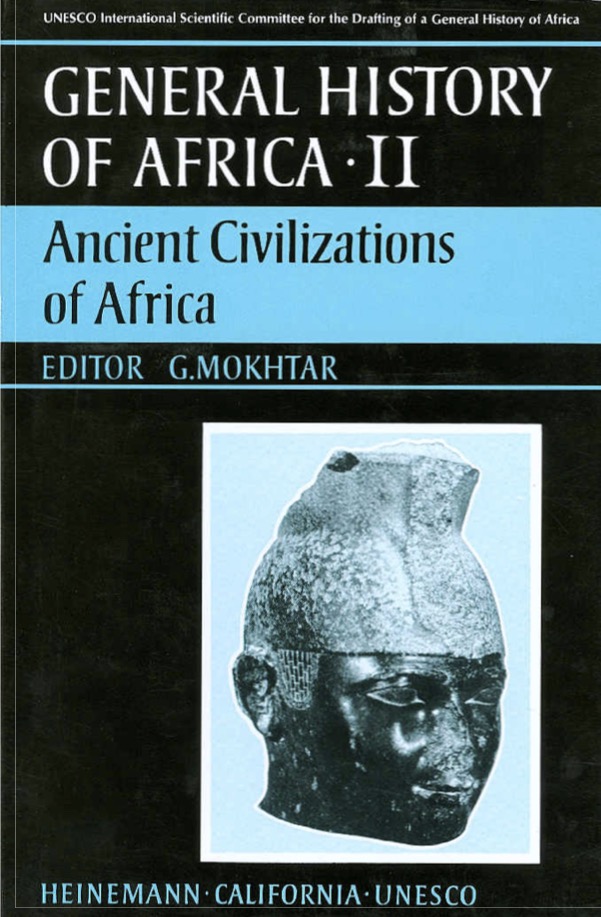
The Unesco General History of Africa, II, Ancient Civilizations of Africa
Book
Mokhtar, G. (1990) The Unesco General History of Africa, II, Ancient Civilizations of Africa. Berkeley, University of California Press, 804 pp.
ISBN/ISSN: 520039130 | Sinkankas/Born No.: NIS / NIB | RWHL
gems, ancient gemology, ancient jewelry, early metallurgy, ancient history, geography, Pliny
This collectively authored volume, edited by G. Mokhtar, surveys the development of African societies from the later prehistoric periods to approximately the seventh century CE, placing the continent’s ancient civilizations within a connected African history. Twenty-nine chapters are organized around four broad regions: Egypt and Nubia, the Ethiopian highlands, North Africa and the Sahara, and sub-Saharan Africa with Madagascar. The substantial treatment of the Nile valley examines the origins of ancient Egyptians, Pharaonic political and social institutions, agriculture, economic organization, religion, writing, artistic and scientific achievements, and Egypt’s relations with other African societies. Hellenistic and Roman Egypt are considered alongside the continuity and transformation of earlier traditions. Chapters on Nubia trace developments through Kerma, Napata, Meroe, and the Christian kingdoms, emphasizing both distinctive local cultures and the region’s role in exchanges between the Mediterranean and the African interior. The Ethiopian section addresses pre-Aksumite societies, Aksum’s political economy and commercial connections, and the establishment of Christianity. North African chapters examine indigenous populations, Carthage, Roman and post-Roman societies, and Saharan settlement and communication. The remaining contributions synthesize evidence for eastern, western, central, and southern Africa, including hunting and gathering, food production, settlement, ironworking, maritime commerce, and emerging social and political complexity. Madagascar is treated through its settlement history and cultural connections across the Indian Ocean. Throughout, environmental change, population movement, technological development, trade, and religious transformation provide themes linking otherwise uneven regional records. The volume challenges historical approaches that detach Egypt and North Africa from the rest of the continent or assume that sub-Saharan history begins only with later written accounts. Archaeological discoveries, inscriptions, linguistic comparisons, material culture, and documentary sources are brought together, while competing interpretations are retained in controversial areas, notably the peopling of ancient Egypt. The editor repeatedly stresses the scarcity and unequal geographical distribution of evidence, uncertainties in chronology, and the provisional character of many reconstructions. The concluding synthesis emphasizes African foundations, local initiative, and interaction with neighboring regions, while identifying research priorities in archaeology, ancient communication routes, migration, language relationships, and cultural exchange. The work offers both an extensive synthesis of scholarship and a framework for further investigation rather than a uniformly documented narrative of the continent’s ancient past.