
Four Treasures Reference Database
Record No. 27
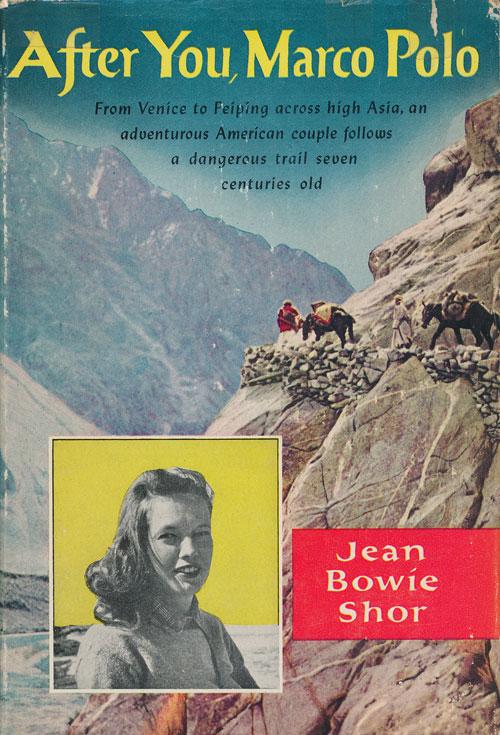
After You, Marco Polo
Book
Shor, J.B. (1955) After You, Marco Polo. New York, McGraw-Hill, 294 pp.
Sinkankas/Born No.: NIS/NIB | RWHL
China, central Asia, Marco Polo, gems
Shor recounts her travels with her husband, Franc, in an attempt to retrace Marco Polo’s route from Venice to China, combining personal adventure, historical comparison, and observations of societies undergoing rapid political change. Opening with a dangerous episode in the Pamirs, where Franc lies seriously ill, she returns to her childhood fascination with exploration, wartime Red Cross service in Italy, and postwar relief work in China. Experiences in Shanghai and Peiping, detention by Communist forces, and a journey across the Gobi establish the background to the couple’s more ambitious expedition. Their subsequent route leads through Turkey, Iran, and Afghanistan toward the Wakhan and Hunza, using whatever transport circumstances permit, from motor vehicles to horses and yaks. Marco Polo’s narrative supplies a continuing point of reference for landscapes, trading centres, local products, and customs, although modern borders, military restrictions, and diplomatic requirements repeatedly complicate attempts to follow his itinerary. Encounters range from conversations with villagers, merchants, guides, and pastoralists to audiences and social occasions with the Shah of Iran, the King of Afghanistan, and the Mir of Hunza. Of particular gemological interest is the account of privileged access to Iran’s crown jewels at Bank Melli in Tehran. Shor describes the elaborate security arrangements, masses of loose gemstones and pearl strands, royal crowns, an emerald-topped snuffbox, a turquoise-decorated gold bowl, and the Daria-i-noor diamond. She records explanations and legends supplied during the visit concerning the treasures’ origins, acquisition, value, and role as backing for the national currency; these passages are eyewitness travel impressions and reported accounts rather than a systematic gemological catalogue. In Afghanistan, the purchase of an inexpensive piece of lapis lazuli and an unsuccessful search for a balas ruby prompt comparisons with Marco Polo’s descriptions of mineral wealth and royal restrictions on gemstone extraction and export. The expedition’s most sustained ordeal unfolds in the Wakhan, where difficult terrain, uncertain supplies, negotiations over transport, severe weather, and illness expose the travellers’ dependence on local assistance. Their intended continuation into China is ultimately prevented by political upheaval and the closure of the frontier, although they reach the crest of the Mintaka Pass before turning back. A concluding stay in Hunza provides observations of agriculture, hospitality, domestic life, government, and polo, contrasting the valley’s relative isolation with the pressures of the surrounding world. Written in an energetic, humorous, and strongly personal voice, the book presents travel as a pursuit sustained by curiosity and human generosity, while its depictions of Asian peoples and political events reflect the author’s American perspective during the early Cold War.