
Four Treasures Reference Database
Record No. 27002
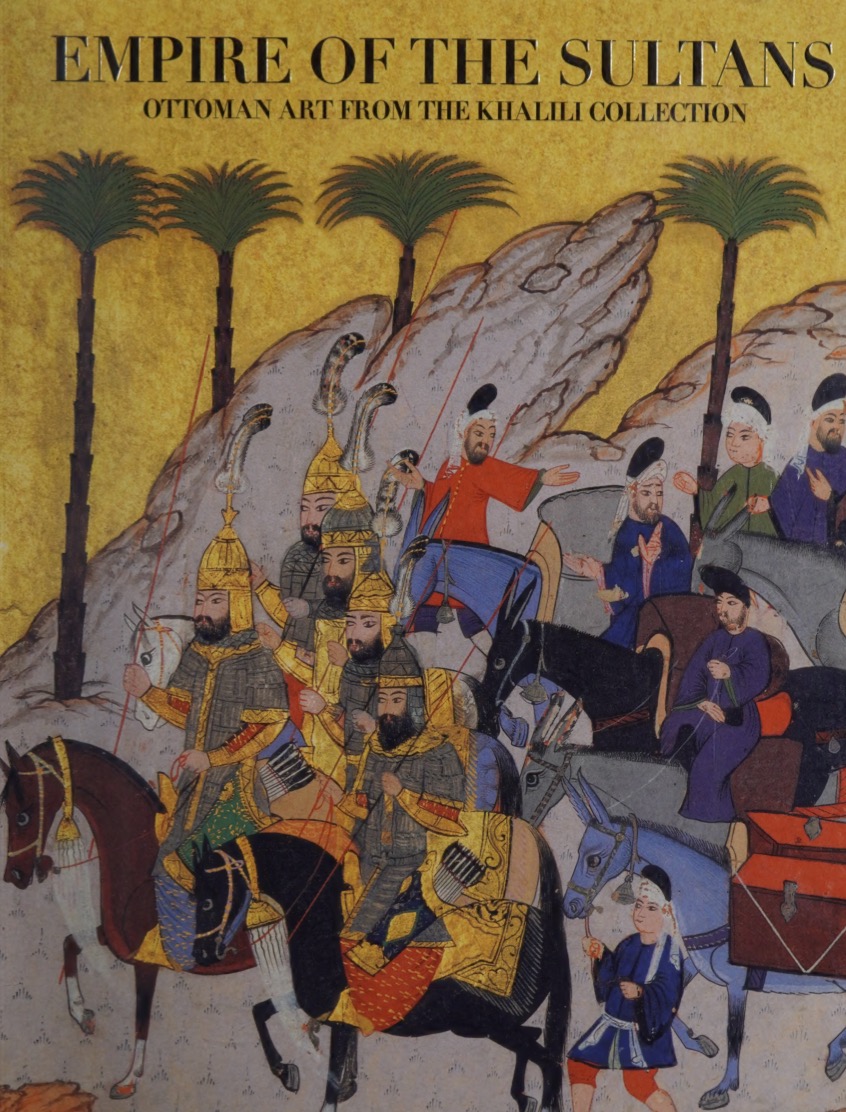
Empire of the Sultans | Ottoman Art from the Khalili Collection
Book
Rogers, J.M. (2002) Empire of the Sultans | Ottoman Art from the Khalili Collection. Alexandria, VA, Art Services International, 304 pp.
ISBN/ISSN: 883971437 | Sinkankas/Born No.: NIS/NIB | RWHL*
gems, Arabic Mineralogy, ancient gems, ancient jewelry, Islamic jewelry, Islamic art
There can be no doubt that the Ottoman Empire was one of the most significant states in the history of Europe and the Middle East. But its history and its artistic production have, I believe, been presented in a rather distorted fashion. The Ottoman dynasty held power for 600 years, an extraordinary achievement in a region where states often rose and fell within a few generations. During that immense period, the extent of the Ottomans’ wealth and power changed enormously. At the turn of the 13th century, the Ottomans held no more than a small area of north-west Anatolia, but by 1500 they were an important regional power, ruling most of modern Turkey and a large part of the Balkan peninsula, and during the 16th century they became masters of a vast, multinational empire that stretched from Slovakia to Nubia and from Algiers to the Caucasus. In the following three centuries there was indeed a net loss of territory, but this hardly justifies the depressing view of many commentators, that the empire reached a peak of power and vitality sometime before 1600 and then spent 300 years gently ‘declining’. Much the same opinion is current about Ottoman art. The golden age is generally thought to have ended about 1600, and everything produced thereafter is considered derivative and uninspiring. But I hope this exhibition will make it clear that Ottoman artists continued to produce equally interesting and beautiful work right up to the last years of the state, in the late 19th and early 20th century. One problem has been that Ottoman art has been represented outside Turkey mostly by decorative arts such as ceramics and textiles that did indeed reach a peak of excellence in terms of design and technique in the 16th century. Even in their own time these products were greatly admired by the kings and princes of Renaissance Europe, who competed with the sultans for the output of workshops created under imperial patronage. Fine examples of them are represented in this exhibition, but they are far from being the only aspect of Ottoman artistic production that deserves our attention. Indeed, if we wish to acquire a full understanding of the Ottoman mentality, then we must turn first to those arts that the Ottomans themselves considered most prestigious, and that role was filled by calligraphy and the arts of the book. I believe that this primacy is reflected in the Kur’ans, fermans, secular manuscripts, inscriptions and other material that form the core of this exhibition. They are matched by a comprehensive range of works in every other medium, selected from the Collection’s holdings of Ottoman art. These objects have given me great pleasure, and I trust they will do the same for visitors to this exhibition. Art Services International have prepared the current tour of this exhibition in the United States, after its successful presentation in Geneva, London and Jerusalem, and I would like to join Lynn K. Rogerson and Joseph W. Saunders in thanking the staff of that organization, and the personnel of the numerous institutions across the country that are hosting Empire of the Sultans. The exhibition would not have been possible without enormous efforts by a group of distinguished specialists in the field, including Professor J.M. Rogers, who is Honorary Curator of the Collection and The Nasser D. Khalili Professor Emeritus of Islamic Art and Archaeology at the School of Oriental and African Studies, University of London. Dr. Julian Raby, who was formerly Lecturer in Islamic Art at the University of Oxford and is now Director of The Freer Gallery of Art and the Arthur M. Sackler Gallery of the Smithsonian Institution, Washington DC, and Nahla Nassar, the Acting Curator of the Collection, also played a great role in the development of the exhibition, for which I thank them. In addition, Nahla has been responsible for co-ordinating the American loan from our end. She deserves great credit for all she has done. The catalogue is a witness to the learning of its author, Professor Rogers. In some instances, he was assisted by other specialists, notably Emilie Savage-Smith, Francis Maddison, Michael Franses, Tim Stanley, Nahla Nassar and Manijeh Bayani, while Julian Raby devised the organization of the catalogue with the intention of emphasizing the primacy of the written word. I would like also to thank those who provided administrative assistance in the course of this project, including Diane Dixson-O’Carroll, Wendy Keelan and the late Sally Chancellor. Sally’s sudden and tragic death in July 1999 has deprived us all of a rock and a friend, and I would like to record again my deep sense of grief at her disappearance from our lives. We are working on a suitable memorial. Finally, I must add a word of appreciation for the love and support of my wife, Marion, and my wonderful sons Daniel, Benjamin and Raphael. They have shown such graceful tolerance of my engagement in yet another time-consuming project. —Nasser D. Khalili, London, 2002.