
Four Treasures Reference Database
Record No. 27015
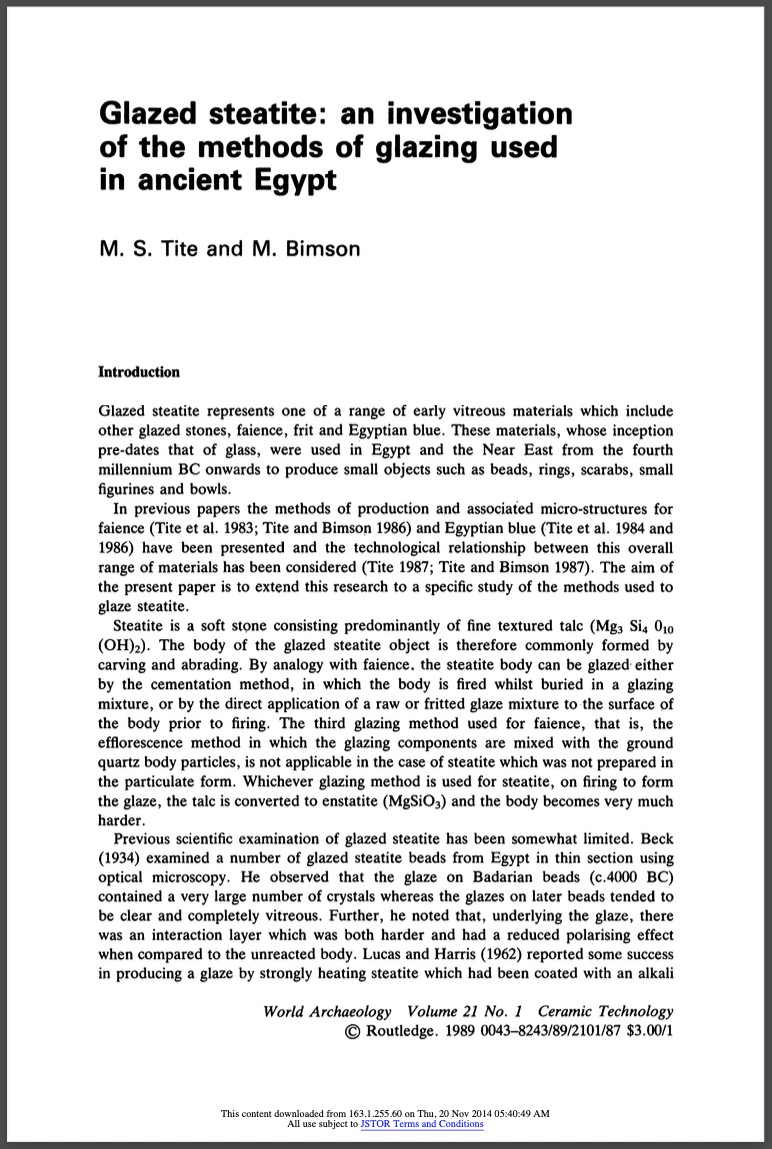
Glazed steatite: An investigation of the methods of glazing used in ancient Egypt
Journal Article
Tite, M.S. and Bimson, M. (1989) Glazed steatite: An investigation of the methods of glazing used in ancient Egypt. World Archaeology, Vol. 21, No. 1, pp. 87–100.
Sinkankas/Born No.: NIS/NIB | RWHL
gems, analytical, treatment, glazed steatite
The microstructures and chemical compositions of a small group of glazed steatite objects from Egypt spanning the period from the fourth to the first millennium BC have been investigated in a scanning electron microscope with attached X‐ray spectrometer. Two primary methods of glazing have been identified. The first was characterised by high copper and magnesium oxide concentrations and a high density of recrystallised forsterite. The second was characterised by lower copper and magnesium oxide concentrations and only a scatter of recrystallised forsterite towards the glaze‐body interface. Laboratory replication has confirmed that the first type of glaze was produced by the cementation method in which the steatite body was fired whilst buried in a glazing mixture and the second type by the direct application of a fritted glaze mixture to the surface of the steatite body prior to firing.