
Four Treasures Reference Database
Record No. 27065
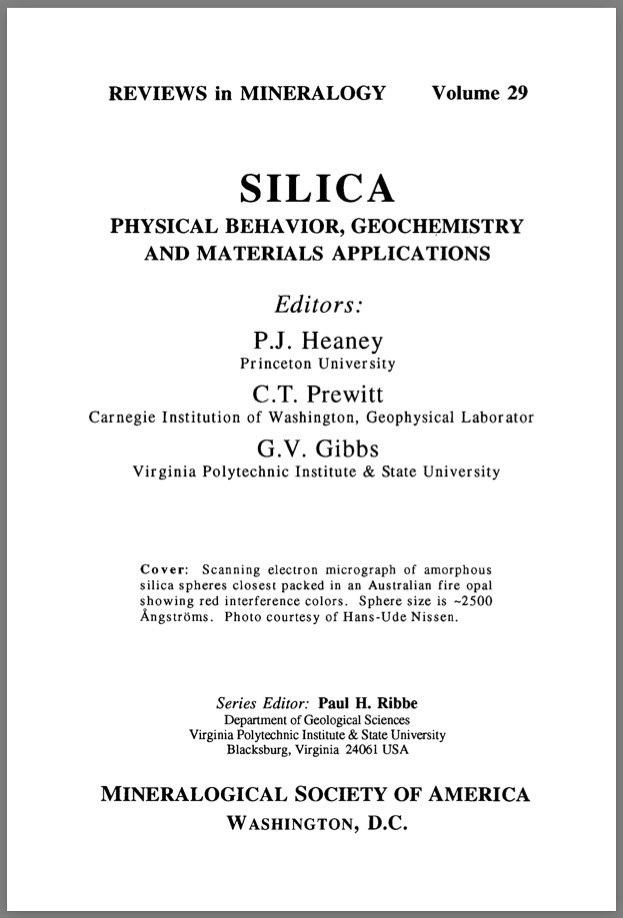
Colored varieties of the silica minerals
Book Section
Rossman, G.R. (1982) Colored varieties of the silica minerals. In: Reviews in Mineralogy: Silica—Physical Behavior, Geochemistry, and Materials Applications, Washington, DC: Mineralogical Society of America, Vol. 29 , pp. 433–467.
Sinkankas/Born No.: NIS/NIB | RWHL
gems, quartz, rose quartz, cause of color in silica minerals
Quartz, when chemically pure SiO₂, is colorless and transparent from about 145 nm in the ultraviolet to about 2700 nm in the infrared when in mm to cm thickness. Natural quartz has three important colored varieties: amethyst (violet), citrine (yellow to brown), and smoky (dark smoky quartz is sometimes called morion). A fourth variety, prasiolite (green), also exists. Each of these varieties exhibits either a substitutional or interstitial component other than Si. In addition to chemical substitutions, development of color in some of these varieties requires exposure to ionizing radiation or heat. Each of these varieties can be produced through heat treatment or irradiation of natural quartz of a different color and can also be produced by direct synthesis or through synthesis followed by irradiation. Other colored varieties of natural quartz (rose, blue, chrysoprase, jasper, etc.) are, in fact, mixtures of quartz and other phases (although there may be a type of rose quartz from substitutional causes alone).