
Four Treasures Reference Database
Record No. 27090
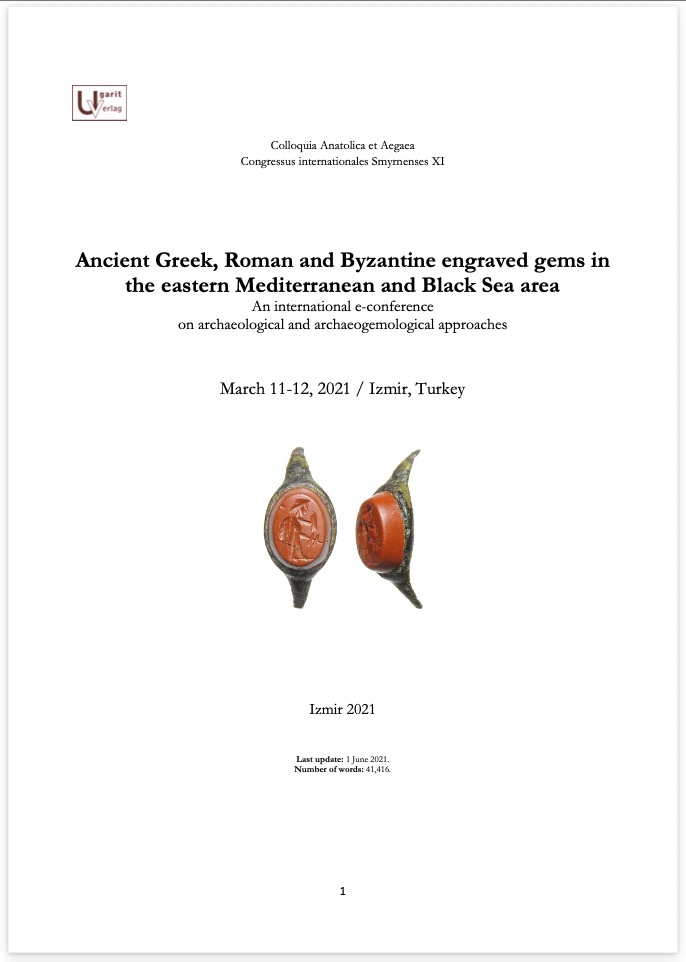
Ancient Greek, Roman and Byzantine engraved gems in the eastern Mediterranean and Black Sea area, An international e-conference on archaeological and archaeogemological approaches, March 11–12, 2021 / Izmir, Turkey
Edited Book
Lafli, E., Çetingöz, A., Veziroğlu, E.M. and Thoen, H., editor (2021) Ancient Greek, Roman and Byzantine engraved gems in the eastern Mediterranean and Black Sea area, An international e-conference on archaeological and archaeogemological approaches, March 11–12, 2021 / Izmir, Turkey.. Izmir, Colloquia Anatolica et Aegaea - Congressus internationales Smyrnenses XI, 121 pp..
ISBN/ISSN: 9786250000000 | Sinkankas/Born No.: NIS/NIB | RWHL
gems, glyptic, engraved gems, agate, cameo, intaglio, scarabs, seals, Greek, Roman, Egyptian
An engraved gem, frequently referred to as an intaglio, is a small and usually semi-precious gemstone that has been carved; in the ancient Greek and Roman tradition, a gem normally bears images and/or inscriptions, often with the figure on one side and an inscription on the other. The engraving of gemstones was a major luxury art form in the ancient eastern Mediterranean. At first, Near Eastern glyptic art dominated the field of small carved stones, such as cylinder seals, and Minoan and Mycenaean glyptic as well as Egyptian carving were extensive. The world of Greek and Roman gems enlarged on that tradition as amulets, with only some functioning as seals, often mounted in a ring. Engraved gems have been found in relatively large quantities in the eastern Mediterranean and Black Sea area, where they were in use and produced frequently between the Bronze Age and Medieval periods. So far, the study of these multifunctional objects has been overlooked in the eastern Mediterranean¹ and there is still a huge amount of unpublished material from excavations and museums in an area from Albania down to Egypt, including Greece, Turkey and Cyprus. Ancient engraved gems can be categorized in the Graeco-Roman eastern Mediterranean; most carved gems originally functioned based on different criteria, including their gemological and mineralogical material, decoration, production, use and distribution. Besides the catalogue of gems in some museums and collections, in recent years some important publications on Greek and Roman gems have appeared, of which a list is given below. The purpose of the present virtual conference was to create an analytical framework for understanding Greek and Roman engraved gems in their social and material contexts. In recent decades, major excavation projects have produced vast quantities of data that have reshaped our understanding of the gems, while also raising new questions about their use and production over the long term. In this online conference we focused on Greek, Roman and Byzantine engraved gems from the eastern Mediterranean and Black Sea area between c. the early sixth century B.C. and early seventh century A.D., and attempted to set out a comprehensive model for the study of engraved gems, including their definition, typology, chronology, contexts, function, regional characteristics and distribution patterns.