
Four Treasures Reference Database
Record No. 27105
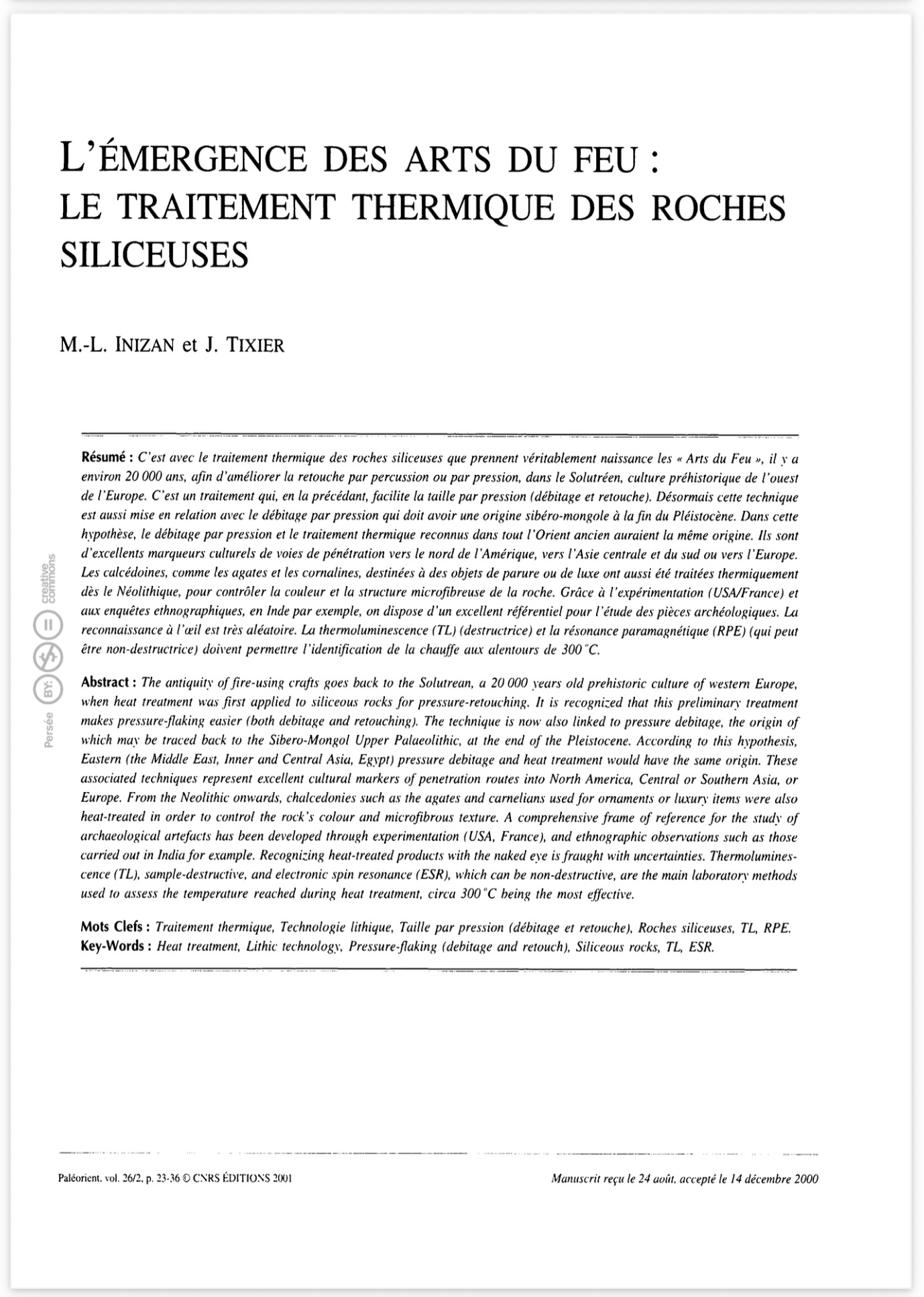
L'émergence des arts du feu: Le traitement thermique des roches siliceuses
The emergence of the fire arts: The heat treatment of siliceous rocks
Journal Article
Tixier, J. and Inizan, M.-L. (2000) L'émergence des arts du feu: Le traitement thermique des roches siliceuses. [The emergence of the fire arts: The heat treatment of siliceous rocks] Paléorient, Vol. 26, No. 2, pp. 23–36.
DOI: http://dx.doi.org/10.3406/paleo.2000.4707 | Sinkankas/Born No.: NIS/NIB | Language: in French | RWHL
gems, quartz, chalcedony, heat treating quartz - chalcedony, carnelian paleolithic, neolithic
The antiquity of fire-using crafts dates back to the Solutrean culture of western Europe, around 20,000 years ago, when heat treatment was first applied to siliceous rocks to facilitate pressure-retouching; this preparatory treatment makes pressure-flaking—both debitage and retouching—easier and is now also associated with pressure debitage, which may have originated in the Sibero-Mongol Upper Paleolithic at the end of the Pleistocene; according to this hypothesis, Eastern techniques of pressure debitage and heat treatment (in the Middle East, Inner and Central Asia, and Egypt) share a common origin and serve as valuable cultural markers tracing routes of penetration into North America, Central or Southern Asia, or Europe; from the Neolithic period onward, chalcedonies such as agate and carnelian, used for ornaments and luxury items, were also heat-treated to control their color and microfibrous structure; a comprehensive framework for studying archaeological artifacts has emerged through experimental archaeology (notably in the USA and France) and ethnographic studies, including those conducted in India; however, visually identifying heat-treated artifacts remains uncertain, and laboratory methods such as thermoluminescence (TL), which is sample-destructive, and electron spin resonance (ESR), which can be non-destructive, are used to determine the heating temperature, with around 300 °C being the most effective.