
Four Treasures Reference Database
Record No. 27106
Implantations humaines et exploitation des obsidiennes en Anatolie centrale durant le Pléistocène
Journal Article
Slimak, L. (2004) Implantations humaines et exploitation des obsidiennes en Anatolie centrale durant le Pléistocène. Paléorient, Vol. 30, No. 2, pp. 7–20.
gems, obsidian, Paleolithic, Anatolia
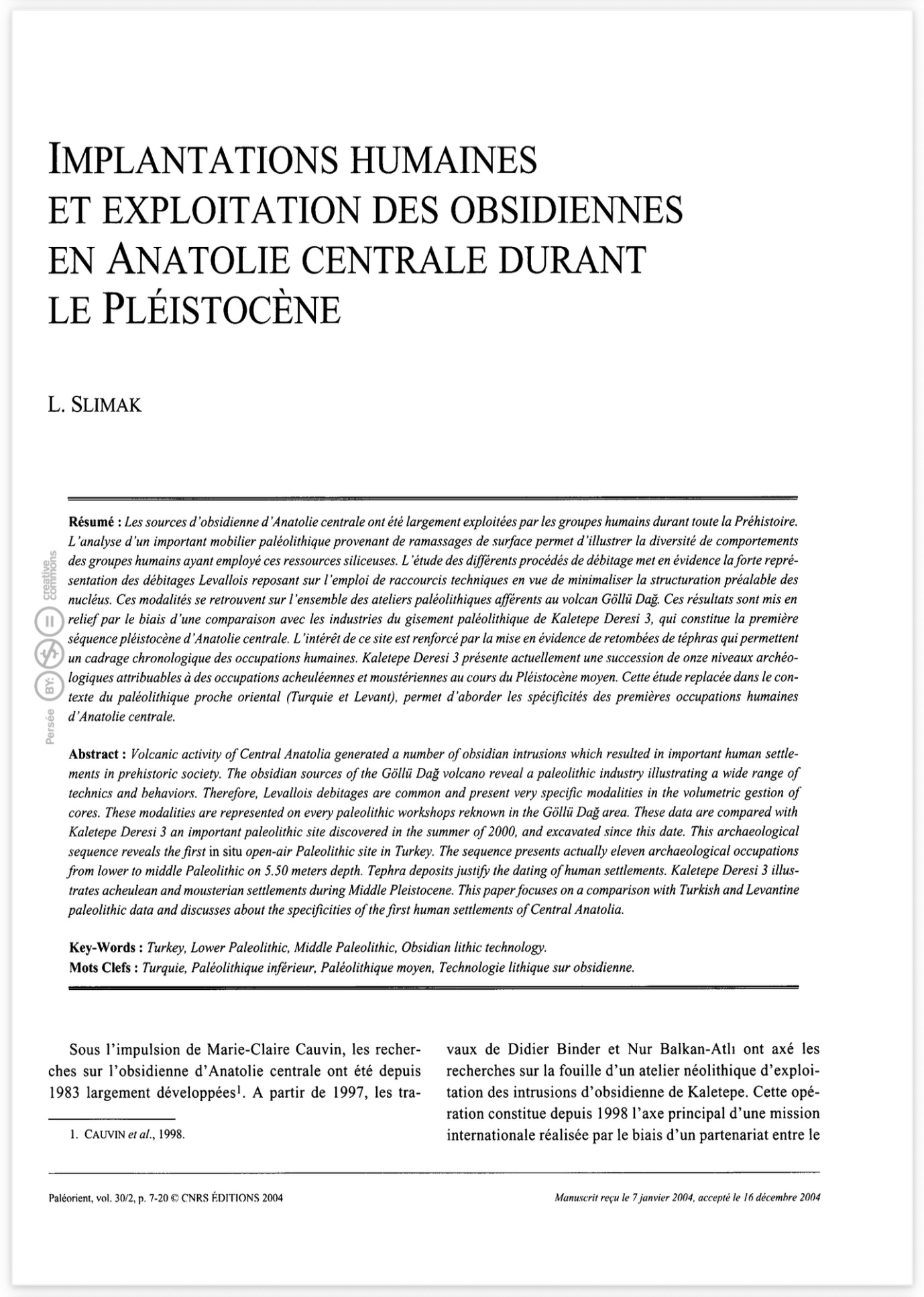
Volcanic activity in Central Anatolia gave rise to several obsidian intrusions that supported significant prehistoric human settlements; the obsidian sources of the Göllü Dağ volcano exhibit a Paleolithic industry marked by diverse techniques and behaviors, with Levallois debitage being common and showing distinct modalities in core volume management, which are consistently represented at all known Paleolithic workshops in the Göllü Dağ region; these findings are compared with Kaletepe Deresi 3, a major Paleolithic site discovered in the summer of 2000 and under excavation since, which constitutes the first known in situ open-air Paleolithic site in Turkey, featuring eleven archaeological layers spanning from the Lower to Middle Paleolithic within a 5.5-meter-deep sequence; tephra layers provide chronological markers for the human occupations, and Kaletepe Deresi 3 preserves evidence of Acheulean and Mousterian settlements from the Middle Pleistocene; the paper compares these findings with broader Turkish and Levantine Paleolithic data and discusses the unique features of early human presence in Central Anatolia.